Why Practice with a Katakana Quiz?
Reading Katakana quickly and accurately is an essential skill for anyone learning Japanese. A Katakana quiz uses active recall — the most effective study technique according to cognitive science research — to strengthen your character recognition far faster than passive review alone.
Active recall works by forcing your brain to retrieve information from memory rather than just recognizing it. Each time you successfully recall a character's reading, the neural pathway strengthens, making future recall faster and more automatic.
- Instant feedback helps identify problem characters immediately
- Randomized ordering prevents memorizing sequences instead of individual characters
- Score tracking provides measurable progress over multiple sessions
- Gamification makes repetitive practice more engaging and sustainable
For best results, take the quiz in short 5-10 minute sessions multiple times per day rather than one long session. Spaced repetition research shows that distributed practice produces significantly better long-term retention.
Basic Katakana Quiz (46 Characters)
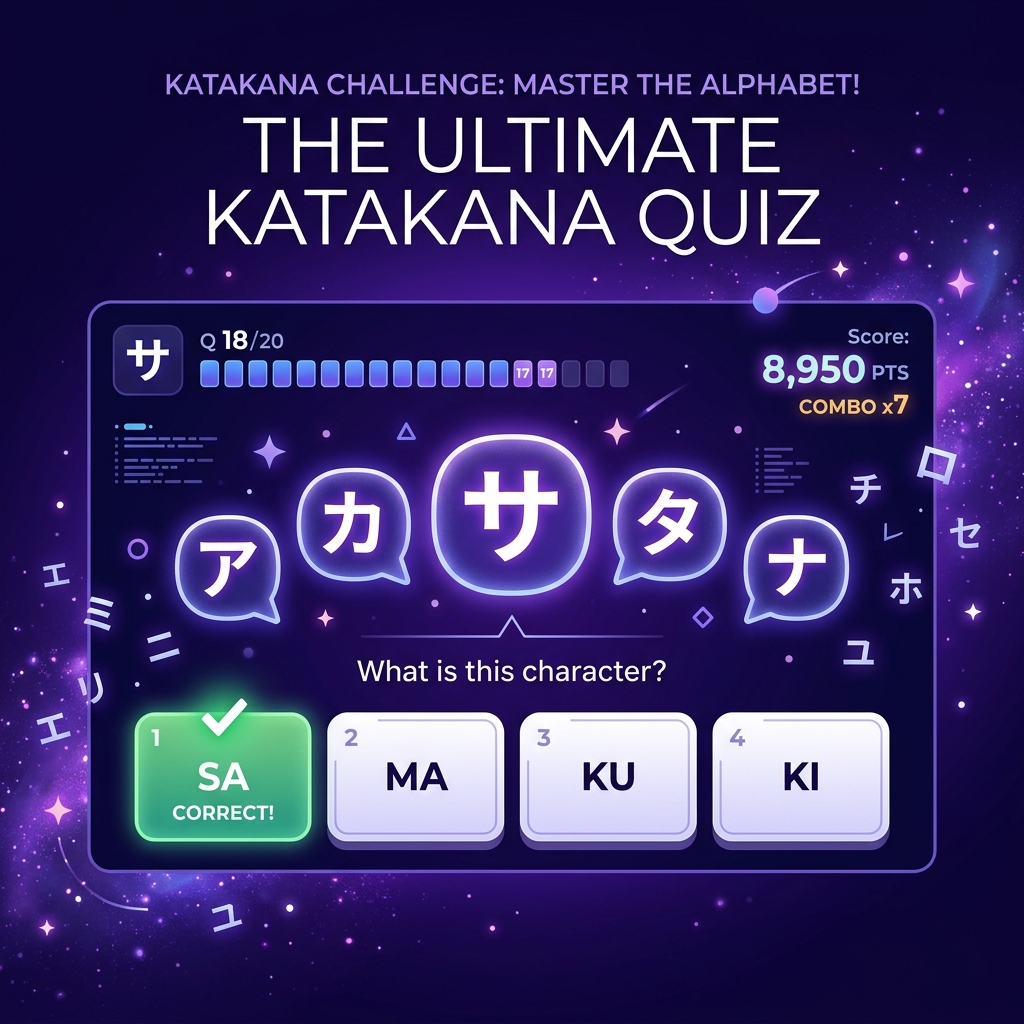
Test your knowledge of all 46 basic Katakana characters. Each question presents a character with four possible romaji readings — select the correct one.
🎯 Basic Katakana Quiz
Select the correct romaji reading for each character.
What is the romaji for this character?
Dakuon & Handakuon Challenge
Ready for a harder challenge? This quiz focuses exclusively on voiced (Dakuon) and half-voiced (Handakuon) characters — the modified Katakana that many learners find tricky.
⚡ Dakuon & Handakuon Quiz
These modified characters are commonly confused. Test your accuracy.
What is the romaji for this character?
Speed Round — Timed Challenge
Think you know your Katakana well? Try the speed round and see how many characters you can identify correctly in 60 seconds. This tests not just accuracy but reading speed — a crucial skill for real-world Japanese reading.
⏱️ 60-Second Speed Challenge
How many can you get right in one minute?
Character Group Mastery
Tips to Improve Your Katakana Quiz Score
- Learn by row — Master one consonant row at a time (vowels → K → S → T...) before mixing them in a combined quiz.
- Focus on confusing pairs — Characters like シ/ツ (shi/tsu) and ソ/ン (so/n) look similar. Practice distinguishing these specifically.
- Write while quizzing — Trace each character on paper as you answer. The motor memory reinforces visual recognition.
- Review wrong answers — After each quiz session, revisit the characters you missed. These are your weakest links.
- Increase speed gradually — Once you can answer accurately, focus on answering faster. Real Japanese reading requires instant recognition.
Watch out for these frequently confused Katakana pairs: シ (shi) vs ツ (tsu), ソ (so) vs ン (n), ス (su) vs ヌ (nu), ウ (u) vs ワ (wa). The stroke direction is the key differentiator.
Často Kladené Otázky
How does the Katakana Quiz work?
Each question shows a Katakana character and four romaji options. Select the correct reading to score a point. You get instant feedback showing the correct answer, and your score is tracked throughout the session.
Can I choose specific character sets to practice?
Yes. Use the different quiz sections above to focus on Basic Katakana (46 characters), Dakuon and Handakuon (voiced/half-voiced sounds), or try the timed speed round that mixes all character types.
How many questions are in the quiz?
The quiz runs continuously with randomized questions, so you can practice as long as you want. Each session tracks your accuracy rate to help you identify characters that need more study.
What are the most commonly confused Katakana characters?
The most commonly confused pairs are: シ (shi) and ツ (tsu), ソ (so) and ン (n), ス (su) and ヌ (nu). These pairs share similar stroke patterns but differ in stroke direction.
Sources & References
- The Japan Foundation — Marugoto: Japanese Language and Culture, Official JLPT preparation materials
- JapaneseJLPT.com — Katakana Quiz: Practice Japanese Katakana Characters
- Tofugu — Learn Katakana: The Ultimate Guide, katakana learning methodology
- Cognitive psychology research on active recall and spaced repetition (Karpicke & Blunt, 2011)
Apply Your Katakana Skills
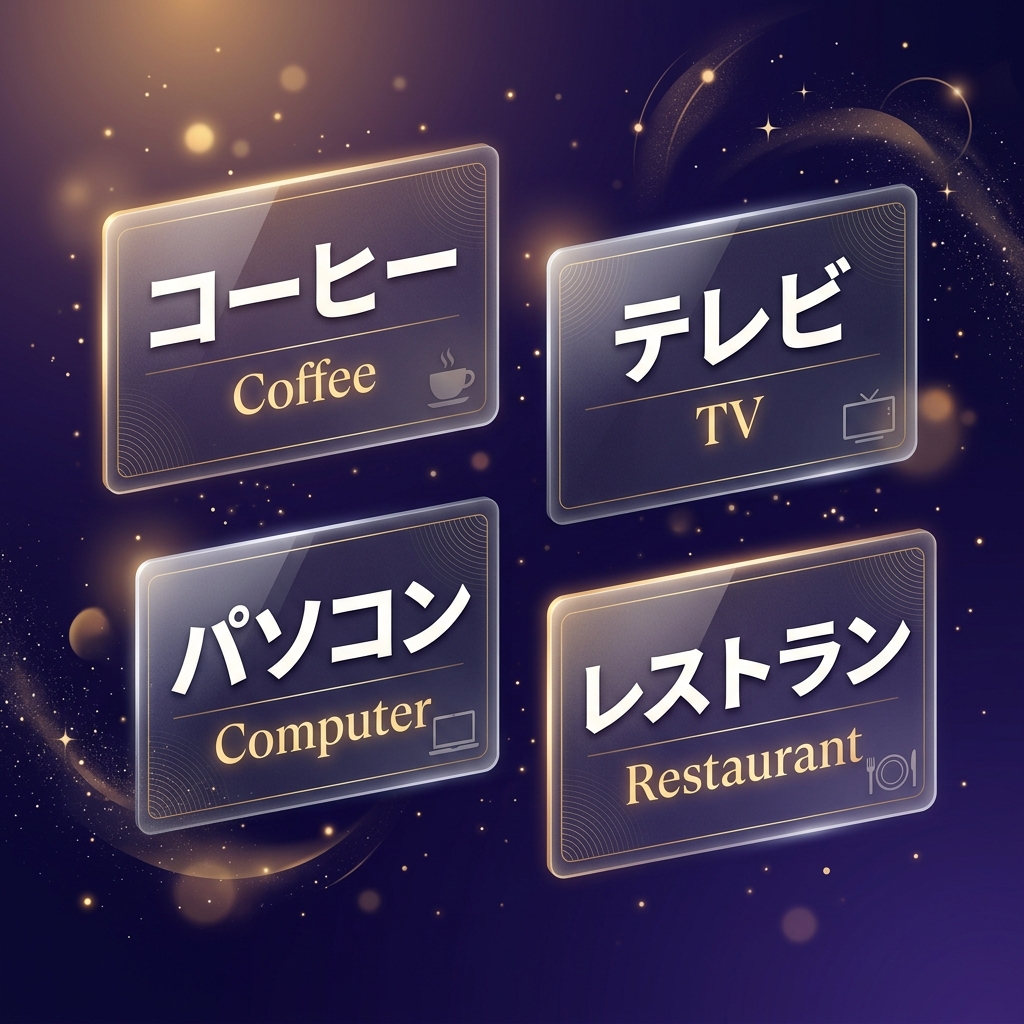
Try converting English words to Katakana to see these characters in real-world context.
Převést na Katakanu →