What Are Hiragana and Katakana?
Japanese uses three writing systems simultaneously: Hiragana (ひらがな), Katakana (カタカナ), and Kanji (漢字). While Kanji are logographic characters borrowed from Chinese, Hiragana and Katakana are both syllabaries — sets of characters where each symbol represents a complete syllable.
Together, Hiragana and Katakana are called Kana (仮名). Both systems represent exactly the same 46 basic sounds and can theoretically write any Japanese word. The critical difference lies in how and when each system is used.
Kana = the general term for both Hiragana and Katakana. Mora = a single unit of sound in Japanese (each kana character = one mora). Gojūon (五十音) = the traditional ordering system for kana characters.
Side-by-Side Character Comparison
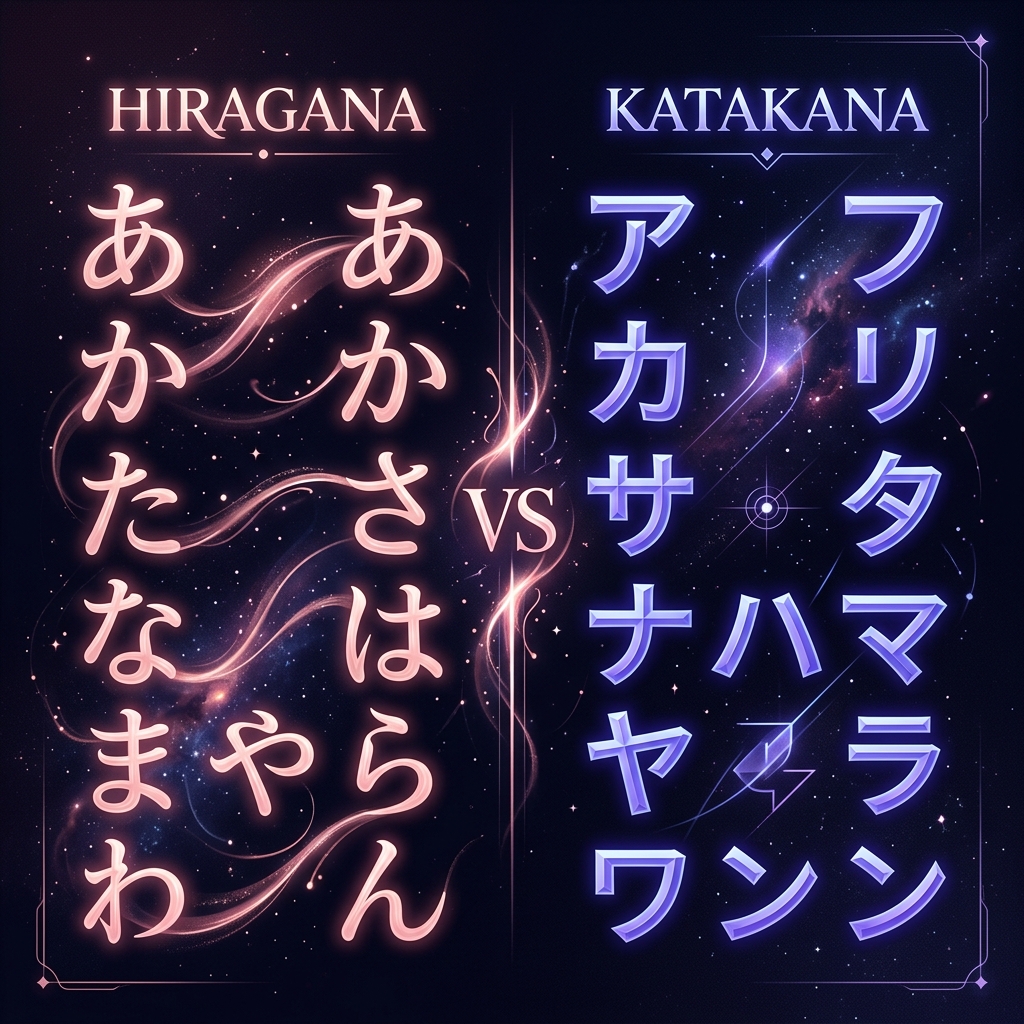
Both Hiragana and Katakana represent the same sounds — the only difference is their visual appearance. Below is a side-by-side comparison of the vowel and consonant characters:
| Sound | Hiragana | Katakana | Romaji |
|---|---|---|---|
| Vowel A | あ | ア | a |
| Vowel I | い | イ | i |
| Vowel U | う | ウ | u |
| Vowel E | え | エ | e |
| Vowel O | お | オ | o |
| Ka | か | カ | ka |
| Ki | き | キ | ki |
| Ku | く | ク | ku |
| Ke | け | ケ | ke |
| Ko | こ | コ | ko |
| Sa | さ | サ | sa |
| Shi | し | シ | shi |
| Su | す | ス | su |
| Se | せ | セ | se |
| So | そ | ソ | so |
| Ta | た | タ | ta |
| Chi | ち | チ | chi |
| Tsu | つ | ツ | tsu |
| Te | て | テ | te |
| To | と | ト | to |
| Na | な | ナ | na |
| Ni | に | ニ | ni |
| Nu | ぬ | ヌ | nu |
| Ne | ね | ネ | ne |
| No | の | ノ | no |
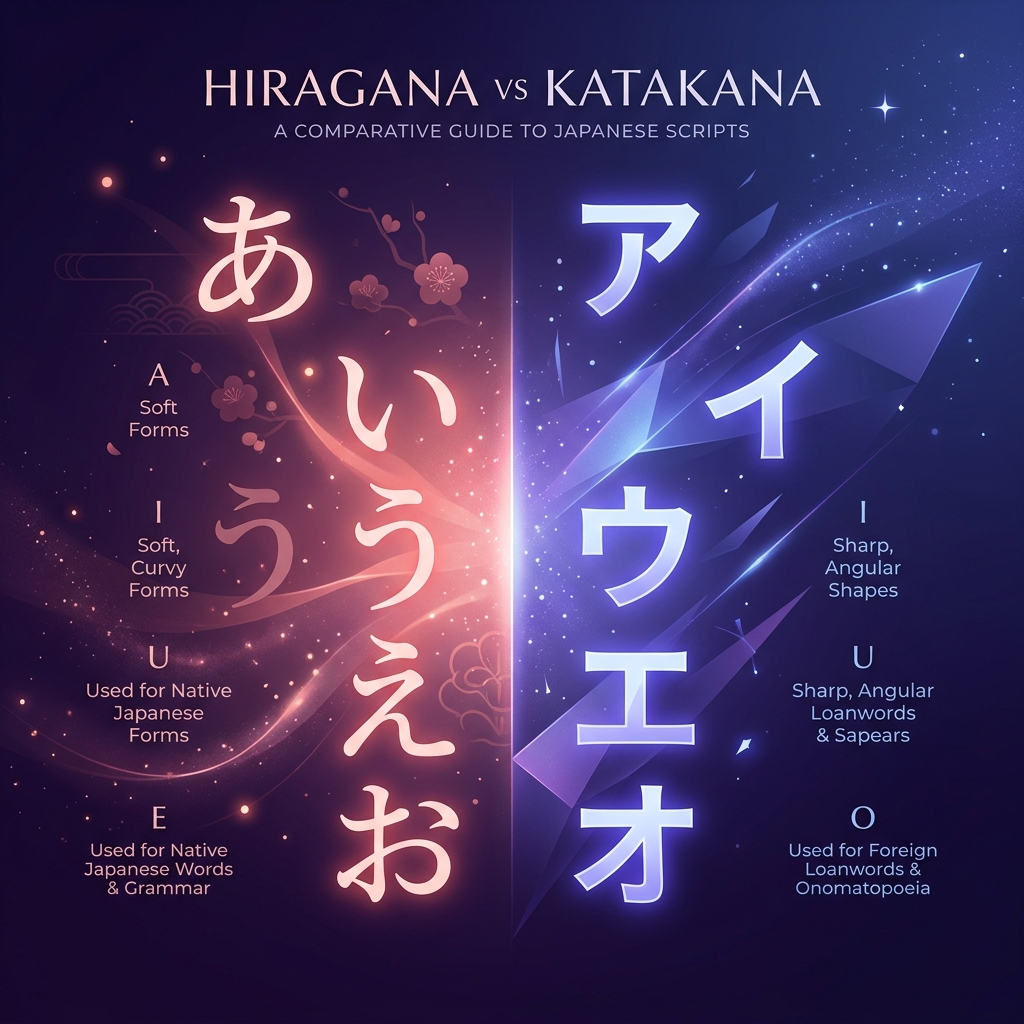
Notice how Hiragana characters have flowing, curved strokes (like cursive), while Katakana characters are sharp and angular (like print). Some pairs look surprisingly similar — like へ (Hiragana "he") and ヘ (Katakana "he"), which are nearly identical!
Key Differences Between Hiragana and Katakana
While both systems represent the same sounds, their differences go beyond visual appearance. Here's a comprehensive breakdown:
| Aspect | Hiragana (ひらがな) | Katakana (カタカナ) |
|---|---|---|
| Visual Style | Rounded, curvy, flowing — like cursive | Sharp, angular, block-like — like print |
| Origin | Simplified from entire cursive Kanji forms | Derived from parts of regular-script Kanji |
| Primary Use | Native Japanese words, grammar particles | Foreign loanwords, scientific terms, emphasis |
| Grammar Role | Particles (は, を, が), verb endings, furigana | Rarely used for grammar; independent words |
| Formality | Standard, everyday writing | Used for emphasis — similar to italics |
| Historical View | Once called "women's writing" (女手) | Used by monks and in official documents |
| Long Vowels | Extra vowel character (e.g., おおきい) | Long dash ー (e.g., コーヒー) |
| Difficulty | Harder to write, easier to encounter | Easier to draw, characters look more similar |
When to Use Each Writing System
Use Hiragana (ひらがな) For:
- Native Japanese words — when no Kanji exists or when the Kanji is too obscure
- Grammatical particles — は (wa), を (wo), が (ga), に (ni), で (de)
- Verb and adjective endings — called okurigana (送り仮名)
- Furigana — small reading aids written above Kanji characters
- Children's content — books and materials for young learners
- Casual, personal writing — letters, notes, informal contexts
Use Katakana (カタカナ) For:
- Foreign loanwords — コンピューター (computer), テーブル (table)
- Foreign names — アメリカ (America), マイケル (Michael)
- Scientific terms — animal/plant names in formal contexts
- Onomatopoeia — sound effects like ドキドキ (dokidoki, heartbeat)
- Emphasis — similar to using italics or ALL CAPS in English
- Company names & brands — トヨタ (Toyota), ソニー (Sony)
Never mix Hiragana and Katakana within a single word in formal writing. Each word should use one writing system consistently. However, a typical Japanese sentence will naturally contain Kanji, Hiragana, and Katakana together.
Usage Distribution in Modern Japanese Text
In a typical Japanese document, the three writing systems appear in roughly the following proportions:
Interactive: Writing System Usage by Context
Origin and History
Both Hiragana and Katakana emerged during the Heian period (794–1185 CE) in Japan. They are believed to have been developed from man'yōgana — Chinese characters used purely for their phonetic values to represent Japanese sounds.
Chinese Characters Arrive in Japan
Kanji was introduced to Japan through contact with China. Japanese people began using Chinese characters to write their own language, matching characters to native words.
Man'yōgana System Develops
Chinese characters began being used purely for their phonetic value (not meaning) to write Japanese words. This system, man'yōgana, was named after the anthology Man'yōshū.
Hiragana and Katakana Are Born
Hiragana evolved from simplified cursive forms of entire Kanji characters, initially popular among women. Katakana was derived from parts of regular-script Kanji, used by monks and scholars.
Katakana Dominant in Formal Writing
Katakana was the preferred script for official documents, legal texts, and formal writing. Schools taught Katakana before Hiragana.
Modern System Established
Educational reforms shifted to teaching Hiragana first. Katakana's role narrowed primarily to foreign words, while Hiragana became the standard script for grammar and native words.
Which Is Easier to Learn?
This question doesn't have a simple answer — it depends on what you mean by "easier":
| Criteria | Hiragana | Katakana |
|---|---|---|
| Writing | ❌ More strokes, complex curves | ✅ Simpler, angular strokes |
| Recognition | ✅ More visually distinct characters | ❌ Characters look more similar to each other |
| Practice Material | ✅ Abundant (children's books, subtitles) | ❌ Less standalone material available |
| Sound Familiarity | ❌ Japanese-origin words may be unfamiliar | ✅ Many words sound like English (loanwords) |
| Real-world Exposure | ✅ Very common in everyday Japanese | ⚡ Common in menus, signs, brand names |
Which Should You Learn First?
Most Japanese language experts and textbooks recommend learning Hiragana first. Here's why:
- Higher frequency — Hiragana appears in approximately 40% of all Japanese text, compared to ~20% for Katakana.
- Grammar essential — All grammatical particles and verb conjugations use Hiragana. You literally cannot form sentences without it.
- Furigana access — Reading aids (furigana) above Kanji are always written in Hiragana, so knowing it helps you learn Kanji pronunciations.
- More varied characters — Hiragana characters are more visually distinct from each other, making initial learning smoother.
Learn both Hiragana and Katakana within a 2-week window. Start with Hiragana for the first week, then tackle Katakana the second week. Because they share identical sounds, learning the second set goes significantly faster. Most dedicated learners can master both in under 10 days.
However, the order ultimately doesn't matter much. What matters is that you learn both quickly. Some learners even prefer to study them in parallel — learning corresponding columns together (e.g., あ/ア, い/イ, う/ウ) to strengthen the sound-character association.
How to Memorize Kana Fast
Here are proven strategies for rapidly learning both writing systems:
1. Writing Practice (Most Effective)
Physically writing characters is the single most effective method. As you write each character, say its pronunciation aloud. The combination of visual, motor, and auditory learning creates strong memory pathways.
2. Mnemonics (Visual Memory Aids)
Associate each character with a picture. For example:
- ア (a) — looks like an axe cutting through wood
- ヌ (nu) — looks like noodles being picked up by chopsticks
- ケ (ke) — looks like a keg of beer on its side
3. Spaced Repetition
Use a flashcard system (like Anki) that shows you characters just before you're about to forget them. This is scientifically proven to optimize long-term retention.
4. Real Content Immersion
Read Japanese menus, product labels, manga, and anime subtitles. Real-world exposure reinforces what you've learned and builds reading speed naturally.
Interactive Comparison Tool
Hover over each character pair below to highlight the Hiragana and Katakana equivalents side by side. This helps build visual recognition of matching pairs.
Quick Quiz: Hiragana or Katakana?
Test your ability to identify whether a character is Hiragana or Katakana.
🧪 Identify the Script
Is this character Hiragana or Katakana?
Which writing system is this character from?
Pertanyaan yang Sering Diajukan
What is the main difference between Hiragana and Katakana?
Hiragana has rounded, flowing strokes derived from cursive Chinese characters, while Katakana has sharp, angular strokes derived from parts of regular-script Chinese characters. Both represent the same 46 sounds but serve different purposes — Hiragana for native words and grammar, Katakana for foreign words and emphasis.
Should I learn Hiragana or Katakana first?
Most experts recommend Hiragana first because it's more frequently used — for grammar particles, verb endings, furigana, and native words. However, the ideal approach is to master both within 1-2 weeks since they represent the same sounds.
Can Hiragana and Katakana be mixed in one word?
No. In standard and formal writing, you should never mix Hiragana and Katakana within a single word. However, a typical Japanese sentence naturally contains all three systems — Kanji for content words, Hiragana for grammar, and Katakana for loanwords.
Why does Japanese need multiple writing systems?
Japanese has very few unique sounds (~100 syllables), leading to thousands of homonyms. Kanji provides visual distinction between words that sound identical. Hiragana handles grammar elegantly, and Katakana clearly marks foreign-origin words. Together, the three systems make written Japanese far more readable and precise than any single system could alone.
How long does it take to learn both Hiragana and Katakana?
With dedicated daily practice, most learners can master both systems in 1-2 weeks. The 46 basic Hiragana can be learned in 3-5 days, and Katakana typically takes a similar time. Since both share the same sounds, learning the second set is usually faster than the first.
Sources & References
- LingoDeer Blog — Differences Between Hiragana and Katakana
- The Japan Foundation — Survey on Japanese-Language Education Abroad, writing system usage statistics
- Agency for Cultural Affairs, Japan — Guidelines for Modern Kana Usage (現代仮名遣い)
- Tae Kim — A Guide to Japanese Grammar, writing systems chapter
Practice What You've Learned
Convert English words to Katakana and see these characters in action with our free converter tool.
Try Katakana Converter →