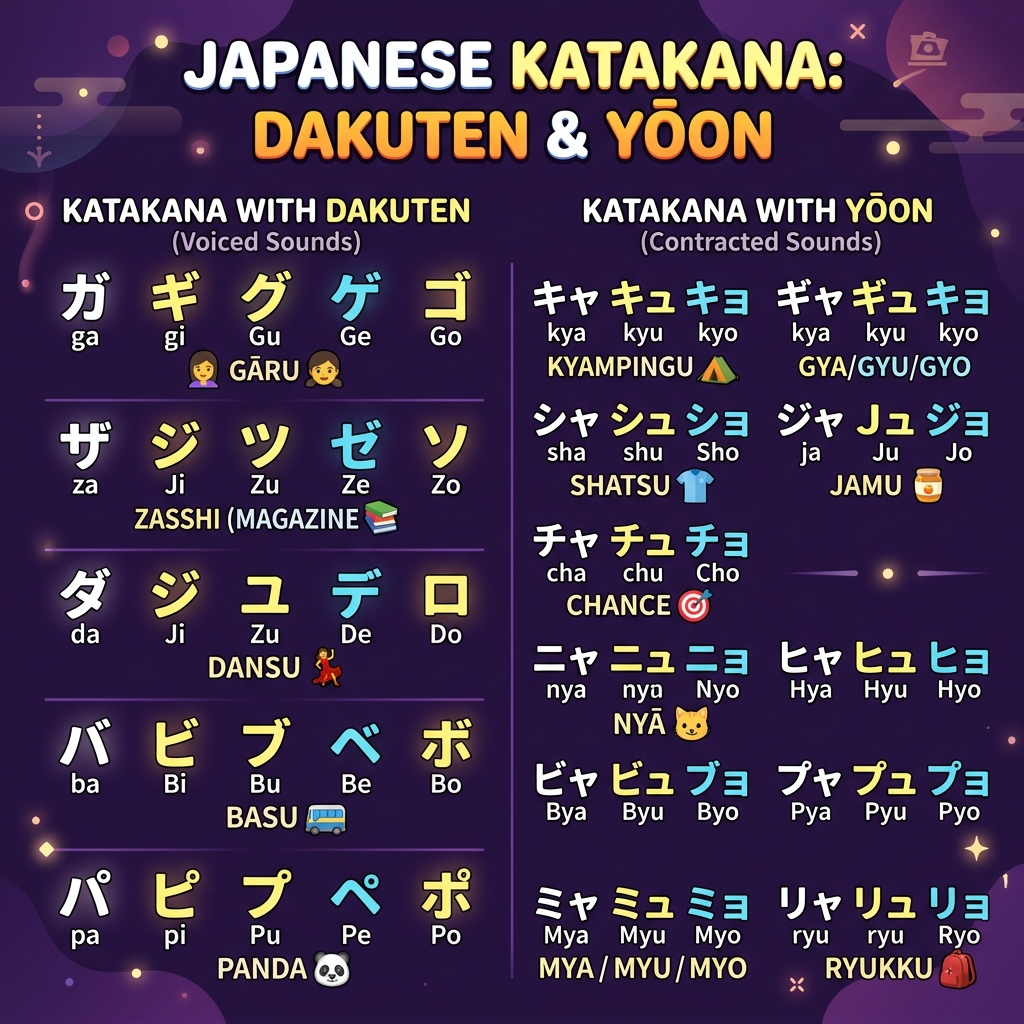
Start with the Base 46 Characters
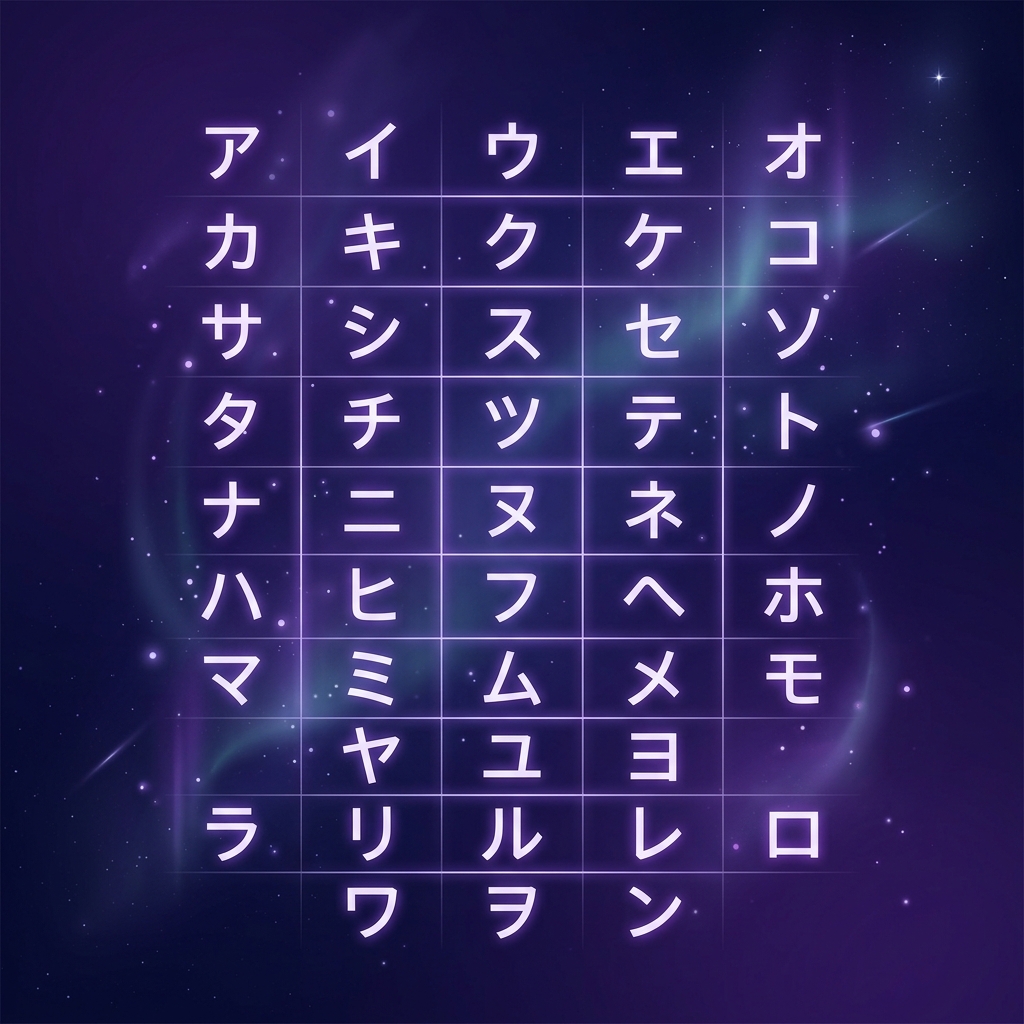
Before exploring modified consonants, voiced sound pairs, and complex contracted syllables, every Japanese learner must build on a solid bedrock. If you are just beginning your Japanese writing journey, we strongly recommend that you start with the base 46 characters. The core Katakana syllabary provides the structural foundation for every sound modification discussed in this guide.
Rather than memorizing more than a hundred arbitrary symbols, the Japanese writing system employs a beautifully systematic phonetic hierarchy. You do not need to memorize completely new letter forms to produce voiced or blended sounds. Instead, once you know the basic 46 kana, two minute diacritical marks—the dakuten (゛) and handakuten (゜)—instantly unlock 25 additional voiced and semi-voiced sounds. Adding three half-sized glide characters (ャ, ュ, ョ) opens up another 33 standard combination sounds, as well as modern extended loanword forms unique to Katakana.
Do not attempt to memorize all 100+ kana in isolation! If you already recognize the foundational rows from our Basic Katakana Chart, learning katakana dakuten and yoon combinations is simply a matter of learning rules of phonetic transformation rather than drawing new shapes from scratch.
What Dakuten (゛) and Handakuten (゜) Do
In Japanese phonology, consonants are categorized by whether they are voiced or unvoiced. Dakuten (濁点, literally "muddy marks" or "voicing marks"), colloquially known as tenten (点々), and handakuten (半濁点, literally "half-muddy marks"), colloquially called maru (丸), are diacritical marks that systematically modify the pronunciation of specific Katakana rows.
The Acoustic Science of Voicing (濁音 - Dakuon)
To understand what dakuten does, place your fingers gently against the front of your throat (on your Adam's apple or larynx) and whisper the sound "ka". Notice that your throat does not vibrate until you voice the trailing vowel. Now, pronounce the sound "ga" out loud. You will immediately feel a buzz of vibration against your fingertips. That physical vibration is your vocal cords engaging.
Consonants produced without vocal cord vibration are termed unvoiced or voiceless consonants (such as [k], [s], [t], and [h]). When you attach the two small diagonal strokes of dakuten (゛) to the upper right corner of an unvoiced kana, it instructs the reader to vibrate their vocal cords while articulating that consonant. This acoustic shift transforms:
- K-consonants into voiced G-consonants (カ ka → ガ ga)
- S-consonants into voiced Z-consonants and J-consonants (サ sa → ザ za, シ shi → ジ ji)
- T-consonants into voiced D-consonants (タ ta → ダ da, テ te → デ de)
- H-consonants into voiced B-consonants (ハ ha → バ ba)
The Bilabial Plosive Transformation (半濁音 - Handakuon)
While dakuten applies to four different consonant rows, handakuten (゜) is strictly unique: it applies exclusively to the five characters of the H-row (ハ, ヒ, フ, ヘ, ホ). Instead of turning them into voiced B-sounds, the tiny hollow circle converts them into crisp, unvoiced bilabial plosives—the P-sounds (パ pa, ピ pi, プ pu, ペ pe, ポ po).
A plosive (or stop) consonant is created by completely closing your lips to block airflow, building slight oral air pressure, and suddenly releasing it in a quick burst. Handakuten is essential for transcribing thousands of international loanwords, from everyday foods like パン (pan, bread) to musical instruments like ピアノ (piano).
Remember this essential progression across the four transformable consonant groups:
カ [ka] → ガ [ga] | サ [sa] → ザ [za] | タ [ta] → ダ [da] | ハ [ha] → バ [ba] → パ [pa]
Notice that only the H-row can take both marks: adding dakuten creates the voiced バ (ba), while adding handakuten creates the plosive パ (pa).
Full Voiced Transformations Table (カ→ガ, サ→ザ, タ→ダ, ハ→バ→パ)
Below is the complete, comprehensive reference table demonstrating all 20 Dakuon characters, all 5 Handakuon characters, and the special loanword dakuten character ヴ (vu). Each entry outlines the base character, modified character, romaji pronunciation, phonetic shift, and a common Japanese loanword example.
| Base Kana | Modified Kana | Romaji | Sound Shift | Example Loanword | English Meaning |
|---|---|---|---|---|---|
| カ (ka) | ガ (ga) | ga | [k] → [g] | ガラス (garasu) | Glass (material) |
| キ (ki) | ギ (gi) | gi | [kʲ] → [ɡʲ] | ギター (gitā) | Guitar |
| ク (ku) | グ (gu) | gu | [k] → [g] | グラス (gurasu) | Drinking glass |
| ケ (ke) | ゲ (ge) | ge | [k] → [g] | ゲーム (gēmu) | Video game |
| コ (ko) | ゴ (go) | go | [k] → [g] | ゴルフ (gorufu) | Golf |
| サ (sa) | ザ (za) | za | [s] → [z] | デザイン (dezain) | Design |
| シ (shi) | ジ (ji) | ji | [ɕ] → [d͡ʑ] / [ʑ] | ジーンズ (jīnzu) | Jeans |
| ス (su) | ズ (zu) | zu | [s] → [z] | チーズ (chīzu) | Cheese |
| セ (se) | ゼ (ze) | ze | [s] → [z] | ゼロ (zero) | Zero |
| ソ (so) | ゾ (zo) | zo | [s] → [z] | ゾンビ (zonbi) | Zombie |
| タ (ta) | ダ (da) | da | [t] → [d] | ダンス (dansu) | Dance |
| チ (chi) | ヂ (ji / di) | ji | [t͡ɕ] → [d͡ʑ] | ラジオヂ (archaic) | Radio dial (rare) |
| ツ (tsu) | ヅ (zu / du) | zu | [t͡s] → [d͡z] | エヅプト (archaic) | Egypt (historical) |
| テ (te) | デ (de) | de | [t] → [d] | デザート (dezāto) | Dessert |
| ト (to) | ド (do) | do | [t] → [d] | ドア (doa) | Door |
| ハ (ha) | バ (ba) | ba | [h] → [b] | バス (basu) | Bus |
| ヒ (hi) | ビ (bi) | bi | [ç] → [bʲ] | ビール (bīru) | Beer |
| フ (fu) | ブ (bu) | bu | [ɸ] → [b] | ブログ (burogu) | Blog |
| ヘ (he) | ベ (be) | be | [h] → [b] | ベッド (beddo) | Bed |
| ホ (ho) | ボ (bo) | bo | [h] → [b] | ボール (bōru) | Ball |
| ハ (ha) | パ (pa) | pa | [h] → [p] | パン (pan) | Bread |
| ヒ (hi) | ピ (pi) | pi | [ç] → [pʲ] | ピアノ (piano) | Piano |
| フ (fu) | プ (pu) | pu | [ɸ] → [p] | プール (pūru) | Swimming pool |
| ヘ (he) | ペ (pe) | pe | [h] → [p] | ペン (pen) | Pen |
| ホ (ho) | ポ (po) | po | [h] → [p] | ポスト (posuto) | Mailbox (Post) |
| ウ (u) | ヴ (vu) | vu | [ɯ] → [v] | ヴァイオリン (vaiorin) | Violin |
Notice the special modern Katakana character ヴ (vu). While traditional Japanese possesses no natural "V" sound, modern loanword orthography permits adding dakuten to the vowel ウ (u) to approximate foreign /v/ phonemes (e.g., ヴァ va, ヴィ vi, ヴ vu, ヴェ ve, ヴォ vo). In casual Japanese, many speakers still substitute the standard B-row (バイオリン instead of ヴァイオリン), but ヴ appears widely in official business branding, trademarks, and translated foreign literature.
Katakana Yoon Combination Sounds (キャ, シュ, チョ)
Yoon (拗音, contracted or twisted sounds) are diphthongal syllables created by combining a Katakana character that ends in the "i" vowel with a reduced, half-sized version of ヤ (ya), ユ (yu), or ヨ (yo): ャ, ュ, and ョ.
The foundational linguistic rule of Yoon is that the combination represents a single mora (one beat of spoken rhythm). In English, a word like "Tokyo" might intuitively look like two or three syllables, but in Japanese, the combination キョ (kyo) is pronounced as one unified vocalization—the consonant [k] is palatalized and blends immediately into the trailing vowel without inserting an extra "i" syllable.
The 33 Standard Yoon Combinations
Standard Japanese incorporates 33 regular Yoon combinations across unvoiced, voiced (dakuon), and semi-voiced (handakuon) consonants. Review the systematic breakdown below:
| Base Kana Row | + ャ (ya) | + ュ (yu) | + ョ (yo) | Common Loanword Example |
|---|---|---|---|---|
| K-Row (キ) | キャ (kya) | キュ (kyu) | キョ (kyo) | キャンプ (kyanpu - Camp), キュート (kyūto - Cute) |
| S-Row (シ) | シャ (sha) | シュ (shu) | ショ (sho) | シャツ (shatsu - Shirt), ショップ (shoppu - Shop) |
| T-Row (チ) | チャ (cha) | チュ (chu) | チョ (cho) | チャンス (chansu - Chance), チョコ (choko - Chocolate) |
| N-Row (ニ) | ニャ (nya) | ニュ (nyu) | ニョ (nyo) | ニュース (nyūsu - News), ニョッキ (nyokki - Gnocchi) |
| H-Row (ヒ) | ヒャ (hya) | ヒュ (hyu) | ヒョ (hyo) | ヒューズ (hyūzu - Fuse), ヒョウ柄 (hyōgara - Leopard print) |
| M-Row (ミ) | ミャ (mya) | ミュ (myu) | ミョ (myo) | ミュージック (myūjikku - Music), ミャンマー (Myanmā) |
| R-Row (リ) | リャ (rya) | リュ (ryu) | リョ (ryo) | リュック (ryukku - Backpack / Rucksack) |
| G-Row (ギ - Voiced) | ギャ (gya) | ギュ (gyu) | ギョ (gyo) | ギャラリー (gyararī - Gallery), ギャグ (gyagu - Joke) |
| Z/J-Row (ジ - Voiced) | ジャ (ja) | ジュ (ju) | ジョ (jo) | ジュース (jūsu - Juice), ジョギング (jogingu - Jogging) |
| B-Row (ビ - Voiced) | ビャ (bya) | ビュ (byu) | ビョ (byo) | ビュッフェ (byuffe - Buffet), ビューティー (byūtī) |
| P-Row (ピ - Semi-Voiced) | ピャ (pya) | ピュ (pyu) | ピョ (pyo) | ピューマ (pyūma - Puma), ピュア (pyua - Pure) |
Extended Katakana Combinations for Foreign Sounds (特殊音)
Because Katakana is specifically designated to transcribe foreign words, standard traditional Japanese phonemes are often insufficient. English and European languages contain consonants like "f", "v", "w", and specific vowel blends like "ti", "di", and "she" that do not exist natively in Japanese.
To overcome this limitation, modern Japanese orthography introduced Tokushuon (特殊音, special sounds). These modern combinations pair full-sized consonants with half-sized vowels (ァ, ィ, ゥ, ェ, ォ) to reproduce international pronunciations accurately:
| Combination Category | Extended Katakana | Romaji | Representative Loanword | English Meaning |
|---|---|---|---|---|
| F-Sounds (フ + small vowel) | ファ | fa | ファッション (fasshon) | Fashion |
| フィ | fi | フィルム (firumu) | Film | |
| フェ | fe | カフェ (kafe) | Cafe | |
| フォ | fo | フォーク (fōku) | Fork | |
| T & D Soft Stops (テ/デ + ィ) | ティ | ti | パーティー (pātī) | Party (not *pāchī) |
| ディ | di | ディナー (dinā) | Dinner (not *jinā) | |
| Tu & Du Sounds (ト/ド + ゥ) | トゥ | tu | タトゥー (tatū) | Tattoo (not *tatsū) |
| ドゥ | du | ドゥードル (dūdoru) | Doodle | |
| W-Glides (ウ/イ + small vowel) | ウィ | wi | ウィスキー (wisukī) | Whisky |
| ウェ | we | ウェブ (webu) | Web (Internet) | |
| ウォ | wo | ウォーター (wōtā) | Water | |
| Sibilant Palatal Blends | シェ | she | シェフ (shefu) | Chef |
| ジェ | je | ジェット (jetto) | Jet | |
| チェ | che | チェック (chekku) | Check / Plaid |
In traditional Japanese, the T-row sounds jump from タ (ta) to チ (chi) and ツ (tsu). Without extended combinations, English words like party would have to be pronounced *pāchī and dinner would be *jinā. The introduction of ティ (ti) and ディ (di) allows modern speakers to pronounce international names and concepts with phonetic fidelity.
Which Combinations Don't Exist and Why?
Learners often ask: "Why can't I put dakuten on マ or ナ? Why is there no handakuten on カ? Why don't we see combinations like カャ or トュ in standard Japanese?" The answers lie in the articulatory mechanics of speech and historical language evolution.
1. Why Dakuten Cannot Attach to Pure Vowels or Sonorants (M, N, R, Y, W)
In linguistic phonetics, consonants fall into two broad classifications: obstruents (stops, fricatives, and affricates) and sonorants (nasals, liquids, glides, and vowels):
- Obstruents (K, S, T, H): Produced by obstructing airflow. They can naturally be spoken either with or without vocal fold vibration (e.g., [k] vs [g], [s] vs [z], [t] vs [d], [p] vs [b]). Hence, dakuten serves a clear acoustic function by flipping the voicing switch.
- Sonorants (M, N, R, Y, W rows and vowels): Produced with continuous, unimpeded resonant airflow. Sonorants are inherently voiced by physical definition. Your vocal cords must vibrate to produce an "m", "n", or "r" sound. Because these consonants are already 100% voiced, adding a dakuten mark is phonetically meaningless. (The only modern exception is ヴ, an artificial 19th-century invention engineered by scholar Fukuzawa Yukichi to symbolize the foreign [v] fricative).
2. Why Handakuten Exists Exclusively on the H-Row
The restriction of handakuten (゜) to the H-row is rooted in historical phonology. In Old Japanese (prior to the 9th century), characters in the H-row were originally pronounced with a voiceless bilabial plosive [p] (*pa, *pi, *pu, *pe, *po). Over centuries, this sound underwent historical weakening (lenition): [p] softened into a bilabial fricative [ɸ], and eventually into the modern glottal fricative [h].
When Portuguese travelers arrived in Japan during the 16th century carrying European loanwords like pão (bread), Japanese speakers needed a diacritic to signal that the consonant should be pronounced with its ancestral popping [p] articulation rather than the weakened [h] sound. Scholars created handakuten specifically to denote this bilabial plosive shift on the H-row. Because no other consonant row ever possessed an ancestral [p] sound, applying handakuten to K, S, or T rows has no historical or phonetic rationale.
3. Why Traditional Yoon Requires an "i"-Ending Base Character
The palatal glide [j] (represented by the "y" sound in ャ, ュ, ョ) requires the tongue body to rise high against the hard palate. In articulatory phonetics, this tongue posture is identical to the vowel position of [i]. Moving your tongue from [i] to [a], [u], or [o] is an effortless, continuous vocal glide. Attempting to create traditional yoon from an "a"-ending or "o"-ending character (such as *カャ or *トュ) requires an unnatural articulatory leap that traditional Japanese phonotactics strictly prohibited.
4. The Yotsugana Merger: Why ヂ (ji) and ヅ (zu) are Missing from Katakana
In classical Japanese, four distinct syllables existed: じ (zi), ぢ (dji), ず (zu), and づ (dzu)—a phonological group known as the Yotsugana (四つ仮名, literally "four kana").
Between the 14th and 17th centuries, an irreversible sound merger occurred in standard Tokyo Japanese. Today, ヂ sounds identical to ジ ([d͡ʑi]), and ヅ sounds identical to ズ ([d͡zɯᵝ]). When modern loanword orthography was standardized in the 20th century, the Agency for Cultural Affairs officially decreed that foreign "j" sounds must be written with ジ (or combinations like ジャ, ジュ, ジョ) and foreign "z" sounds with ズ.
As a direct result, ヂ and ヅ are practically extinct in modern Katakana. You will virtually never see them in everyday Japanese loanwords, menus, or technical vocabulary.
Common Learner Errors & How to Avoid Them
Even advanced students can stumble over the nuances of Katakana dakuten and yoon. Below are the six most frequent errors encountered by learners, along with foolproof strategies to eliminate them.
1. Sizing Trap: Writing Full-Size Kana Instead of Subscripts
The most rampant mistake among beginners is writing small combination kana at full size (e.g., writing キヤ instead of キャ, or シヨツプ instead of ショップ). In Japanese, size changes the rhythm, mora count, and meaning entirely:
- キャ (kya): 1 mora (1 beat). A palatalized, single syllable.
- キヤ (ki-ya): 2 morae (2 beats). Two distinct syllables pronounced in sequence.
- Real-world consequence: ビヨウ (biyō) means "beauty" or "hair salon", while ビョウ (byō) means a "second" of time or a medical condition. Mixing them up leads to immediate miscommunication!
2. Confusing Dakuten (゛) with Handakuten (゜) on Screens
On smartphones, low-contrast computer displays, or small printed menus, the two small diagonal ticks of dakuten look deceptively similar to the small circle of handakuten. Confusing バ (ba) with パ (pa), or ビ (bi) with ピ (pi), is extremely common.
Whenever you see the round circle of handakuten (゜), think of a popping party balloon or soap bubble: the round circle represents a P-sound (パ pa, ピ pi, プ pu, ペ pe, ポ po). The two straight slashes of dakuten (゛) represent two heavy footsteps or drums: the voiced B-sound (バ ba, ビ bi, ブ bu, ベ be, ボ bo).
3. Keyboard IME Typing Pitfalls
Learners often struggle to generate the exact Katakana combinations they want when typing on computer keyboards or smartphone IMEs:
- Standard Yoon: Do not type "ki" then "ya". Simply type the combined syllable:
kya→ キャ,shu→ シュ,cho→ チョ,ryu→ リュ. - Standalone Small Kana: If you ever need to type a small character by itself, prefix it with an
x(orlfor "little"): typingxyagives ャ,xtsugives ッ, andxagives ァ. - Extended Loanwords: Modern IMEs include intuitive shortcuts: typing
thiproduces ティ,dhiproduces ディ,faproduces ファ,weproduces ウェ, andvaproduces ヴァ.
4. The Two-Syllable Pronunciation Drag
English speakers tend to pronounce combination sounds by splitting them into two syllables—saying "kee-yah" for キャ or "shee-yah" for シャ. In Japanese, this distorts the musical rhythm of the language. Practice pronouncing the consonant and glide simultaneously in one snappy beat: release the consonant directly into the glide.
5. Omitting the Small Sokuon (ッ) in Combination Loanwords
Foreign loanwords frequently feature double consonants alongside yoon combinations. Beginners often forget the small ッ (sokuon), which marks an abrupt stop or pause before the next consonant:
- Correct: ショップ (shoppu, shop) | Incorrect: *ショプ (shopu)
- Correct: キャッシュ (kyasshu, cash) | Incorrect: *キャシュ (kyashu)
- Correct: チップ (chippu, tip / computer chip) | Incorrect: *チプ (chipu)
Try the Tool: Convert Romaji and English to Katakana
Ready to see how dakuten, handakuten, and yoon combinations work in real-time? You don't have to guess whether an English name or foreign loanword uses single characters, voiced marks, or extended glide combinations.
Convert Any English Word or Name to Katakana
Use our specialized Romaji to Katakana Converter or our primary converter tool to instantly turn English words, names, and romaji syllables into authentic, phonetically accurate Japanese Katakana with correct dakuten and yoon marks applied automatically.
Try Romaji to Katakana Tool → Main Katakana Converter →Frequently Asked Questions
What is the difference between dakuten and handakuten in Katakana?
Dakuten (゛), informally called tenten, consists of two small diagonal slashes added to the K, S, T, and H rows to voice their consonants (turning K→G, S→Z/J, T→D, and H→B). Handakuten (゜), or maru, is a small circle applied exclusively to the H-row characters (ハ, ヒ, フ, ヘ, ホ) to transform them into crisp, unvoiced P-sounds (パ, ピ, プ, ペ, ポ).
How many Katakana combination sounds (Yoon) are there?
Traditional Japanese writing includes 33 standard Yoon combinations created by pairing an [i]-vowel kana with a half-sized ャ (ya), ュ (yu), or ョ (yo). Furthermore, modern Katakana features over 15 extended combinations (Tokushuon), such as ティ (ti), ディ (di), ファ (fa), and ウィ (wi), specifically designed to transcribe international loanwords.
Why are ヂ (ji) and ヅ (zu) almost never used in Katakana?
Due to the historical Yotsugana merger, ヂ became phonetically identical to ジ (both pronounced [d͡ʑi]), and ヅ became identical to ズ (both pronounced [d͡zɯᵝ]). Because modern loanword transcription prioritizes standard phonetic spelling, authorities standardized all foreign "j" sounds as ジ (or combinations like ジャ, ジュ, ジョ) and foreign "z" sounds as ズ. Consequently, Katakana ヂ and ヅ are virtually obsolete in modern loanwords.
How do you type small Katakana yoon characters on a computer keyboard?
To type combination characters naturally, type the combined romaji: kya gives キャ, shu gives シュ, and cho gives チョ. If you need an isolated small kana, type an x or l before the syllable (e.g., xya produces ャ, xtsu produces ッ). For extended loanwords, standard shortcuts include thi for ティ, dhi for ディ, and fa for ファ.
Why don't the M, N, and R rows take dakuten?
From an acoustic phonetics standpoint, nasals (m, n) and liquids (r) are sonorants—they are inherently voiced consonants by physiological definition. Your vocal cords must vibrate to create them. Because dakuten exists specifically to introduce vocal cord vibration to unvoiced obstruents, adding dakuten to an already-voiced sonorant is acoustically redundant.
Sources & References
- Agency for Cultural Affairs, Government of Japan (文化庁) — Guidelines for the Notation of Foreign Words (外来語の表記), Cabinet Notification No. 2
- The Japan Foundation — Japanese Language Education Syllabary and Phonetics Standard
- NHK Broadcasting Culture Research Institute — NHK Japanese Pronunciation and Accent Dictionary (新編 日本語発音アクセント辞典)
- Vance, Timothy J. — The Sounds of Japanese, Cambridge University Press
- Learn Japanese Adventure — Katakana Combination and Dakuon Charts