The Acoustic Wall: English vs. Japanese Sound Systems
Have you ever wondered why native Japanese speakers struggle to distinguish "light" from "right", why "McDonald's" morphs into the seven-syllable Makudonarudo, or why an English name like "Smith" ends up as Sumisu? These transformations are not random quirks or cultural misunderstandings. They are the rigorous, predictable consequences of phonological conflict between two fundamentally incompatible speech architectures.
Consider the structural mismatch between both languages:
- English Phonology: Features 24 consonant phonemes, roughly 14 to 20 vowel and diphthong sounds, flexible stress-timed rhythm, and dense consonant clusters where up to three consonants can begin a syllable (string) and four can conclude it (twelfths).
- Japanese Phonology: Features only about 14 to 16 consonant phonemes, exactly 5 pure vowels (a, i, u, e, o), strict mora-timed rhythm (isometric beats), and an unyielding Consonant-Vowel (CV) syllable constraint. With the sole exception of the nasal coda ン (n), no consonant can exist without an accompanying vowel.
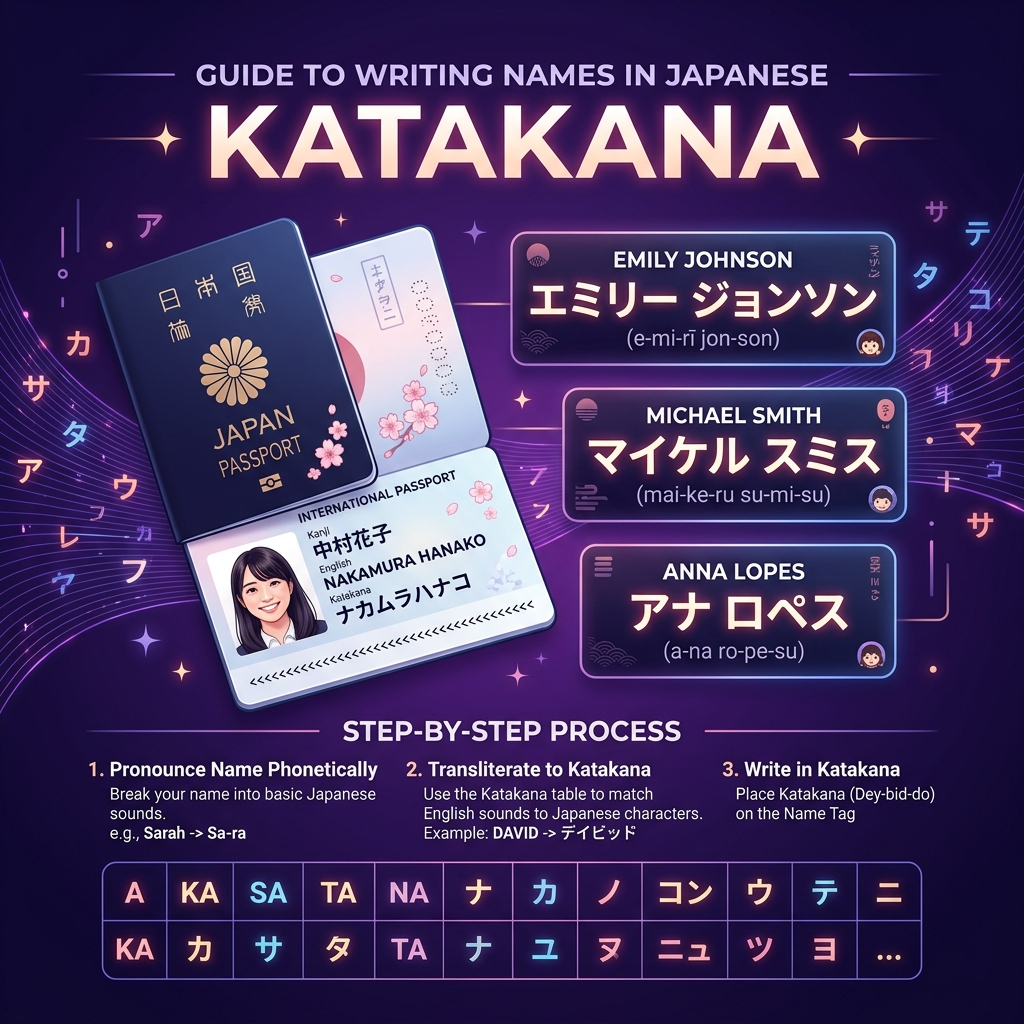
When an English name, loanword, or phrase crosses into Japanese, its sounds smash against this acoustic wall. To survive, the word must undergo systematic surgery: missing consonants are mapped to the closest phonetic neighbors, consonant clusters are broken up by inserted buffering vowels, and vowels are elongated. To see these sound adjustments happen in real time, try our online katakana converter, or review our comprehensive master pillar on How to Write Your Name in Katakana.
The Notorious "Japanese L R Sound" Deep Dive
No phonetic feature in the Japanese language has generated as much confusion as the Japanese L R sound. Pop culture often caricatures Japanese speakers as "mixing up L and R." In reality, from the perspective of native Japanese neurology and phonetics, neither sound exists in Japanese.
The Articulatory Anatomy of English L vs. R
In English, /l/ and /r/ are completely distinct phonemes produced in entirely different areas of the mouth:
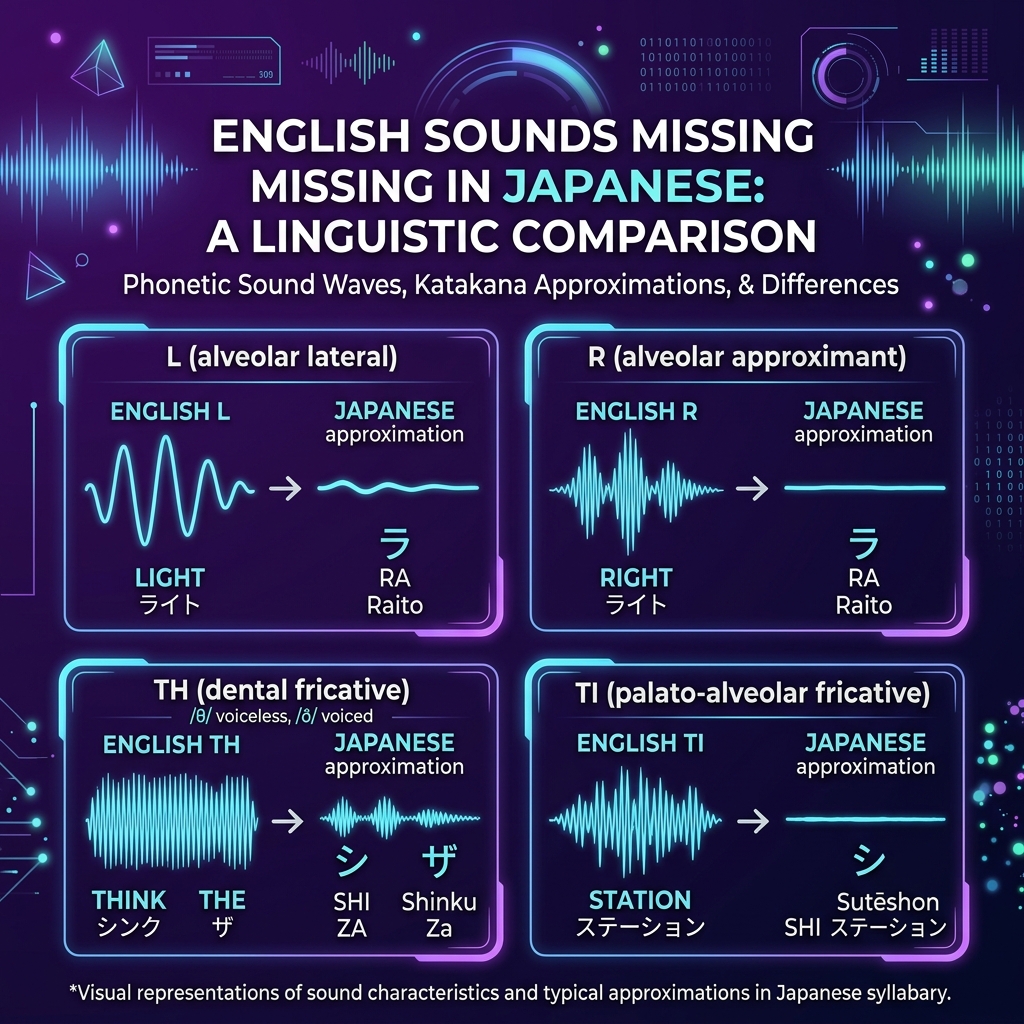
- English "L" [l] (Alveolar Lateral Approximant): The tip of your tongue presses firmly against the alveolar ridge (the gum ridge directly behind your upper front teeth), forcing air to flow around the sides of your tongue.
- English "R" [ɹ] (Postalveolar Approximant): The body of your tongue curls upward or bunches backward near the roof of your mouth without making physical contact, producing a hollow, liquid acoustic resonance.
The Japanese Solution: The Alveolar Flap [ɾ]
Japanese possesses neither of these sounds. Instead, all characters in the Japanese R-row (ラ, リ, ル, レ, ロ) are articulated as an alveolar tap or flap [ɾ]. The tongue tip rises briskly and taps the alveolar ridge once in a rapid, percussive motion—virtually identical to the quick flap Americans use when pronouncing the "tt" in water or butter, or the single "r" in Spanish pero.
Because the Japanese brain categorizes sound according to its native phonemic inventory, the acoustic frequencies of English [l] and English [ɹ] fall into the same mental bucket: the Japanese tap [ɾ]. Therefore, Katakana makes zero orthographic distinction between L and R:
- Light and Right are both written as ライト (raito)
- Glass and Grass are both written as グラス (gurasu)
- Luke and Rook are both written as ルーク (rūku)
The "V" Problem: From Bilabial B to Modern ヴ
English contains a voiced labiodental fricative [v], produced by resting your upper teeth against your lower lip and vibrating your vocal cords (as in violin, video, or David). Classical Japanese phonology possessed no sound requiring teeth-to-lip contact.
The Traditional Solution: Voiced Bilabial Stop (B-Row)
For centuries, foreign words containing "V" were adapted using the closest voiced consonant available: the voiced bilabial stop B-row (バ, ビ, ブ, ベ, ボ). This is why historical loanwords in modern Japanese retain B-spellings:
- Video → ビデオ (bideo)
- Vanilla → バニラ (banira)
- Volleyball → バレーボール (barēbōru)
- David → デビッド (debiddo)
The Modern Katakana Innovation: ヴ (vu)
In the late 19th century, during Japan's rapid Meiji-era Westernization, prominent educator and philosopher Fukuzawa Yukichi introduced the symbol ヴ (u + dakuten) to explicitly transcribe foreign "V" sounds. Today, modern Katakana uses ヴ paired with half-sized vowels to represent international words and names with precision: ヴァ (va), ヴィ (vi), ヴ (vu), ヴェ (ve), ヴォ (vo).
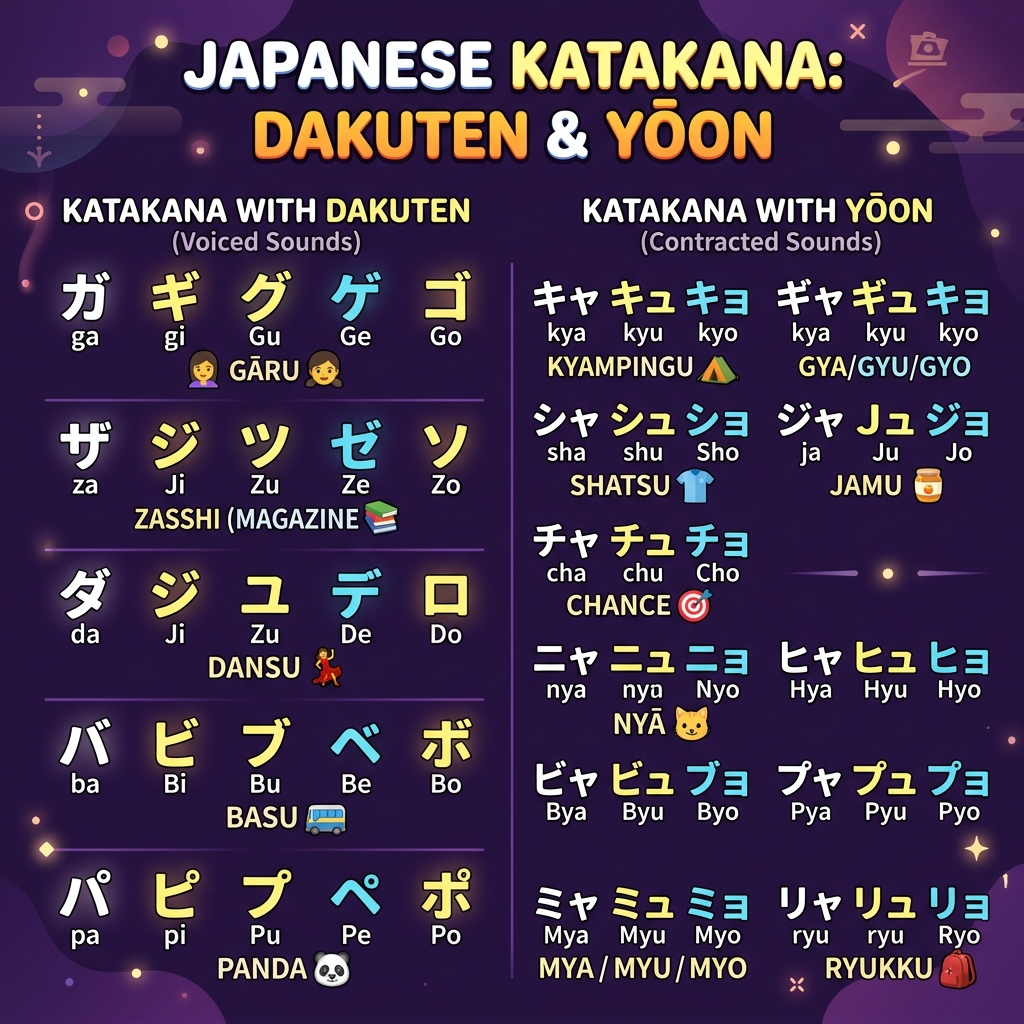
Modern speakers accept both forms: you can write the name Olivia as either conversational オリビア (oribia) or refined オリヴィア (orivia). For a full breakdown of how dakuten operates, explore our guide on Katakana Dakuten & Yoon Combinations.
The "TH" Dilemma: Dental Fricatives to S and Z
English features two dental fricatives created by slipping the tip of your tongue between your teeth: the unvoiced /θ/ (as in think, bath, Arthur) and the voiced /ð/ (as in this, mother, leather). Japanese has no dental fricatives whatsoever.
| English TH Sound | Acoustic Nature | Japanese Katakana Substitute | Worked Example |
|---|---|---|---|
| Unvoiced /θ/ (think, Smith, Keith) | Voiceless dental friction | S-Row (サ, シ, ス, セ, ソ) | Smith → スミス (sumisu) Think → シンク (shinku) |
| Voiced /ð/ (leather, Heather, breathe) | Voiced dental friction | Z-Row (ザ, ジ, ズ, ゼ, ゾ) | Leather → レザー (rezā) Heather → ヘザー (hezā) |
The SI/TI and TU/DU Cluster Breakdown
In classical Japanese phonotactics, specific consonant rows undergo involuntary palatalization or affrication when paired with the high front vowels [i] and [u]. This creates major hurdles for foreign words:
The SI Breakdown
In native Japanese, the S-consonant cannot cleanly pair with [i]. Pronouncing [s] before [i] naturally pulls the tongue backward, turning the sound into シ (shi) [ɕi]. Consequently, English words with "si" naturally collapse into "shi":
- System → システム (shisutemu)
- Simple → シンプル (shinpuru)
- Cinema → シネマ (shinema)
The TI and TU Breakdown
Traditional T-row kana jump from タ (ta) straight to affricates チ (chi) [t͡ɕi] and ツ (tsu) [t͡si]. Historical Japanese has no native "ti" or "tu". Without modern accommodations, party became *pāchī and ticket became chiketto (チケット).
To resolve this, modern Katakana engineered extended combinations (Tokushuon) using subscript vowels:
- テ + small ィ = ティ (ti): Party → パーティー; Timothy → ティモシー
- デ + small ィ = ディ (di): Dinner → ディナー; Building → ビルディング
- ト + small ゥ = トゥ (tu): Tattoo → タトゥー; Twitter → トゥイッター
- ド + small ゥ = ドゥ (du): Doodle → ドゥードル; Fondue → フォンデュ
Consonant Clusters & Vowel Insertion Rules
Because Japanese syllables must end in a vowel, English words packed with consonant clusters require the insertion of "cushioning" or "epenthetic" vowels. Japanese applies strict, predictable insertion rules:
- After T and D consonants: Insert the vowel [o]. Because [u] would turn T and D into affricates (チ chi / ツ tsu), Japanese uses [o] to preserve the dental plosive: Cat → キャット (kyatto); David → デビッド (debiddo).
- After C, K, S, P, B, G, F, M, L consonants: Insert the neutral vowel [u]: Milk → ミルク (mi-ru-ku); Desk → デスク (de-su-ku).
- After Ch and J affricates: Insert the vowel [i]: Beach → ビーチ (bīchi); Page → ページ (pēji).
20 Before/After Sound Transformation Examples
The table below provides 20 real-world before/after examples demonstrating how these core phonological rules transform English words into authentic Japanese Katakana.
| English Word | English Phonemes | Katakana | Romaji | Linguistic Transformation Rule |
|---|---|---|---|---|
| Light / Right | /laɪt/ vs /ɹaɪt/ | ライト | ra-i-to | Neutralization of L and R into Japanese flap [ɾ]; [o] added to terminal 't'. |
| Glass / Grass | /ɡlæs/ vs /ɡɹæs/ | グラス | gu-ra-su | Consonant cluster 'gl/gr' buffered with [u]; L/R merged to ラ; final 's' takes [u]. |
| Vanilla | /vəˈnɪlə/ | バニラ | ba-ni-ra | Voiced labiodental 'V' maps to bilabial 'B' (バ); English 'l' maps to 'ra'. |
| Video | /ˈvɪdioʊ/ | ビデオ | bi-de-o | 'V' maps to 'B' (ビ); 'de' preserved; terminal 'o' open vowel. |
| Virus | /ˈvaɪrəs/ | ヴァイラス / ウイルス | vai-ra-su / u-i-ru-su | Modern English loanword uses ヴァ; standard medical term follows German Virus (ウイルス). |
| Think | /θɪŋk/ | シンク | shin-ku | Unvoiced 'TH' (/θ/) maps to S-row (シ); terminal 'k' buffered with [u]. |
| Thank you | /ˈθæŋk juː/ | サンキュー | san-kyū | Unvoiced 'TH' maps to サ (sa); 'k-you' forms yoon combination キュー. |
| Leather | /ˈlɛðər/ | レザー | re-zā | 'L' maps to 're'; voiced 'TH' (/ð/) maps to Z-row (ザ) with long vowel mark (ー). |
| Mother | /ˈmʌðər/ | マザー | ma-zā | Voiced 'TH' maps to ザ (za) with elongation; initial 'm' open. |
| Rhythm | /ˈrɪðəm/ | リズム | ri-zu-mu | 'R' maps to 'ri'; voiced 'TH' maps to ズ (zu); syllabic 'm' buffered with [u] (ム). |
| Party | /ˈpɑːrti/ | パーティー | pā-tī | Extended combination ティ (ti) avoids traditional affrication to *pāchī. |
| Ticket | /ˈtɪkɪt/ | チケット | chi-ket-to | Historical loanword retains traditional T-row affrication チ (chi); 'ket' takes sokuon ッ. |
| Digital | /ˈdɪdʒɪtəl/ | デジタル | de-ji-ta-ru | 'Di' softened to デ (de); 'gi' voiced affricate ジ (ji); 'tal' becomes タル (ta-ru). |
| System | /ˈsɪstəm/ | システム | shi-su-te-mu | 'Si' palatalized to シ (shi); 's' cluster buffered with [u]; 'tem' buffered with [u]. |
| Sea / She | /siː/ vs /ʃiː/ | シー | shī | Complete phonological collapse: both "sea" and "she" map to elongated シー. |
| Fast food | /ˌfæst ˈfuːd/ | ファストフード | fa-su-to fū-do | Extended combination ファ (fa); 'st' buffered into su-to; 'food' elongated フード. |
| Water | /ˈwɔːtər/ | ウォーター | wō-tā | W-glide combination ウォ (wo) elongated; terminal 't' takes [a] with elongation (ター). |
| Check | /tʃɛk/ | チェック | chek-ku | Affricate チェ (che) paired with small ッ (sokuon) and terminal ク (ku). |
| McDonald's | /məkˈdɒnəldz/ | マクドナルド | ma-ku-do-na-ru-do | Consonant cluster expansion: 4 English syllables expand into 7 Japanese morae. |
| Strike | /straɪk/ | ストライク | su-to-ra-i-ku | Initial triple consonant cluster 'str' expands into three open morae (su-to-ra). |
Try the Tool: English Name to Katakana
Now that you understand the exact phonological mechanics governing English and Japanese sound systems, see how these rules apply to your personal name.
Convert Any English Word or Name to Katakana
Use our dedicated English Name to Katakana Tool to see how complex English consonant clusters, L/R sounds, and silent letters are automatically adapted into natural Japanese script.
Try English Name to Katakana Tool →Frequently Asked Questions
Why is the Japanese L/R sound so difficult for English speakers?
The Japanese 'R' sound (found in the R-row: ラ, リ, ル, レ, ロ) is an alveolar tap/flap [ɾ], acoustically distinct from both the English lateral 'L' [l] and the American liquid 'R' [ɹ]. Because Japanese treats [l] and [r] as non-contrastive allophones of a single consonant category, both English sounds are mapped to the Japanese R-row.
How does Japanese pronounce the English 'V' sound?
Traditionally, Japanese speakers substitute the voiced bilabial stop 'B' (the B-row: バ, ビ, ブ, ベ, ボ) for English 'V' sounds (e.g., video becomes ビデオ bideo). In modern written Katakana, the special character ヴ (u with dakuten) is used for accurate foreign transliteration (e.g., ヴァイオリン vaiorin).
Why does 'McDonald's' become 'Makudonarudo' in Japanese?
Japanese syllables strictly follow a Consonant-Vowel (CV) pattern and do not allow standalone consonants (except 'n'). To pronounce a consonant-heavy English name like McDonald's, Japanese phonology inserts buffering vowels ([u] after k, d, and [o] after d) to break the word into seven distinct open syllables: Ma-ku-do-na-ru-do.
How does Japanese handle the English 'TH' sound?
Because Japanese lacks dental fricatives, the unvoiced 'TH' (/θ/ as in think or Arthur) is replaced by the S-row (シンク shinku; アーサー āsā). The voiced 'TH' (/ð/ as in this or leather) is replaced by the Z-row (レザー rezā).
What is the difference between チ (chi) and ティ (ti) in Katakana?
チ (chi) is a traditional Japanese mora that affricates before the vowel 'i'. In contrast, ティ (ti) is a modern extended Katakana combination (Tokushuon) created by combining テ (te) with a small ィ (i), allowing speakers to pronounce words like 'party' (パーティー) without defaulting to 'ch' (*pāchī).
Sources & References
- Vance, Timothy J. — The Sounds of Japanese, Cambridge University Press
- Shibatani, Masayoshi — The Languages of Japan, Cambridge Language Surveys
- NHK Broadcasting Culture Research Institute — Japanese Pronunciation & Accent Dictionary (新編 日本語発音アクセント辞典)
- Agency for Cultural Affairs, Japan (文化庁) — Guidelines on Foreign Word Notation (外来語の表記)