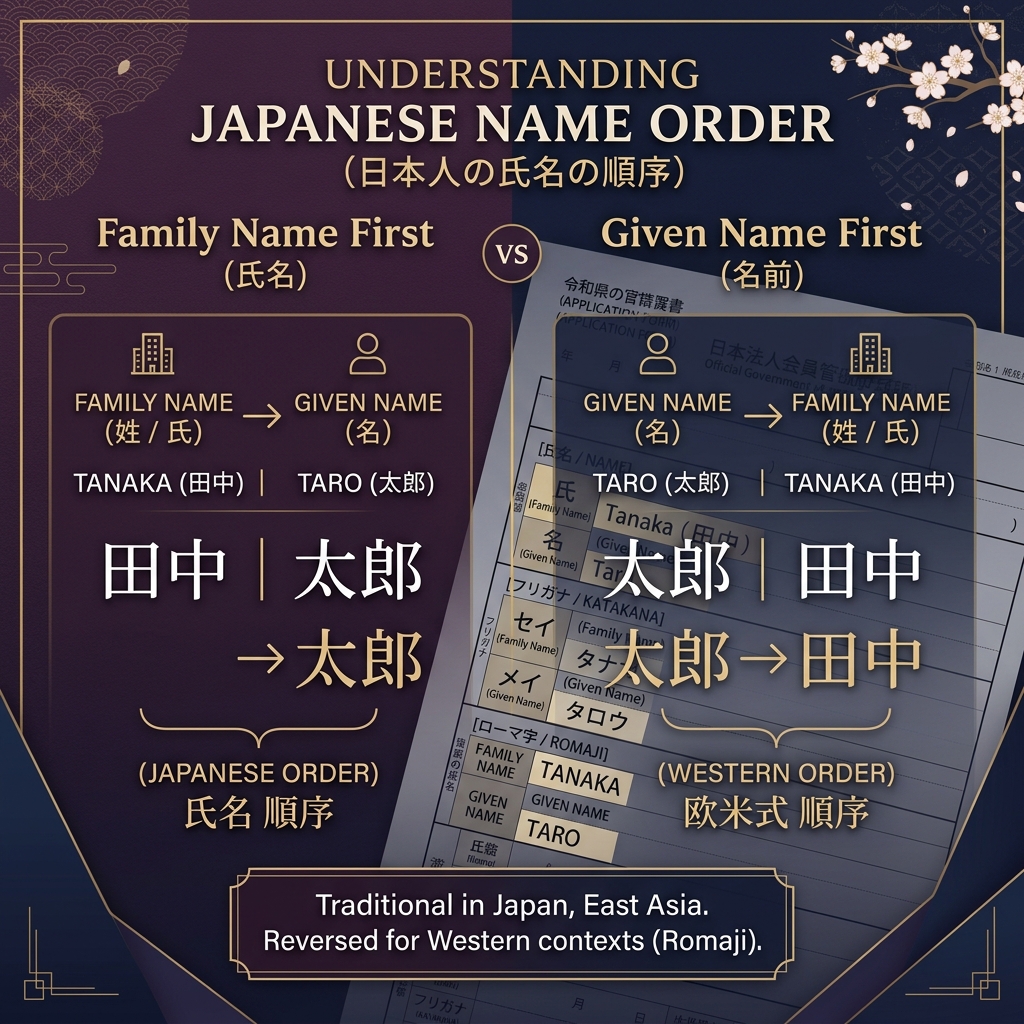
The Cultural Architecture: Why Family Name Comes First
In the Western world, people are introduced given-name-first: John Smith, Emily Davis, Michael Jordan. Your personal, individual name precedes the ancestral surname you share with your relatives. But step into Japan, and the world flips: the family name always comes first, followed by the given name.
If you meet someone named 田中 太郎 (Tanaka Tarō), 田中 (Tanaka) is their family name, and 太郎 (Tarō) is their personal given name. In Japanese conversation, they will be addressed as "Tanaka-san", never "Tarō-san" unless you are on intimate terms with their family.
The Philosophical Roots of Eastern Name Order
This naming architecture is deeply tied to historical Confucian and East Asian communal philosophy. Historically, the family lineage (the ie system) was the foundational unit of Japanese society. The individual existed as a custodian of their ancestral household. Placing the family name first announces one's ancestral lineage, community belonging, and collective social standing before identifying the individual person.
The 2020 Japanese Government Policy Shift
For over a century following the Meiji Restoration (1868), Japanese diplomats, politicians, and businesspeople adopted Western name order when communicating in English (introducing themselves as "Shinzo Abe" instead of "Abe Shinzo"). However, in January 2020, the Japanese government officially ended this practice. Official state documents, diplomatic communiqués, and news agencies now preserve traditional Japanese order in international English contexts: KISHIDA Fumio, ABE Shinzo, and OHTANI Shohei (frequently capitalizing the surname to avoid international ambiguity).
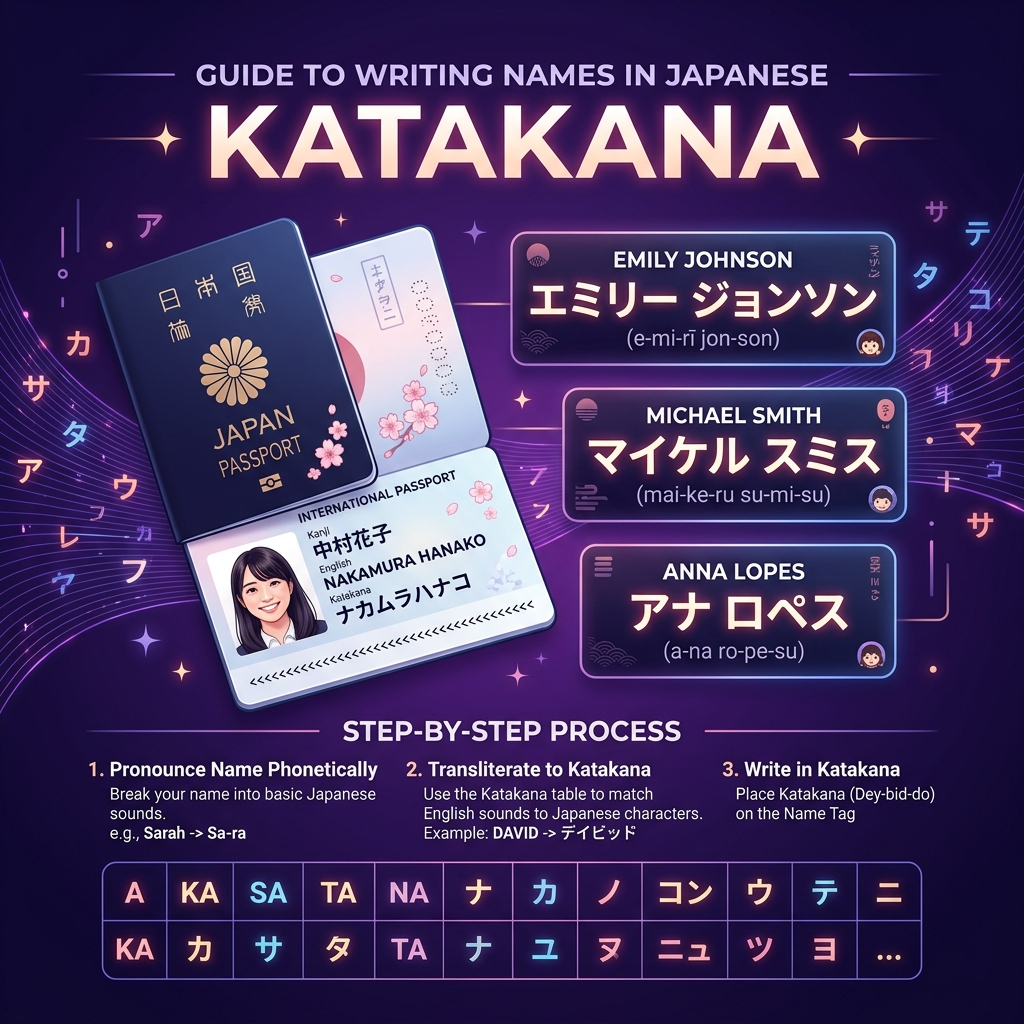
Before considering how to format your own name, make sure you know how to write it phonetically using a reliable online katakana converter, or read our foundational pillar on How to Write Your Name in Katakana.
Does Family-Name-First Apply to Foreigners?
The single most common dilemma faced by travelers, expats, and students moving to Japan is: "Should I flip my name to Last Name First when I introduce myself in Japanese?"
The answer depends entirely on the social versus bureaucratic context:
1. Casual & Social Encounters: Keep Your Western Order
When introducing yourself at a party, to classmates, or during casual networking, native Japanese speakers expect Westerners to maintain their natural cultural order: Given Name + Family Name.
- "初めまして、ジョン・スミスです。" (Hajimemashite, Jon Sumisu desu. — "Nice to meet you, I'm John Smith.")
- Flipping your name in casual conversation to "スミス・ジョンです" will often confuse Japanese listeners, who may assume "Smith" is your given name and begin calling you "Smith-kun".
2. Administrative, Legal & Government Contexts: Passport Order (Surname First)
When you enter a municipal city hall (区役所 / 市役所), open a bank account, sign an apartment lease, or register for National Health Insurance, the rules reverse completely. Japanese government databases match your identity to the machine-readable zone of your passport, which universally formats names as:
SURNAME << GIVEN NAMES (e.g., SMITH << JOHN MICHAEL)
On your Japanese Residence Card (在留カード, Zairyū Card), your name will be printed strictly as SMITH JOHN MICHAEL. On official Japanese paperwork, you must conform to this surname-first sequence.
How to Fill Out Japanese Government & Bank Forms
Japanese administrative forms can feel intimidating. Here is the anatomical breakdown of how to navigate standard Japanese name fields correctly:
| Field Label | Japanese Kanji | What It Means | How Foreigners Should Fill It Out |
|---|---|---|---|
| 氏名 | Shimei | Full Legal Name | Write your full name matching your passport (alphabet or Katakana as specified by the form). |
| 姓 / 氏 | Sei / Shi | Family Name (Surname) | Write ONLY your surname (e.g., スミス / SMITH). |
| 名 | Mei | Given Name (First Name) | Write your given name and any middle names (e.g., ジョン / JOHN). |
| フリガナ | Furigana (Katakana) | Phonetic Reading in Katakana | Write your name in full-width Katakana across the respective 姓 and 名 boxes. |
| ふりがな | Furigana (Hiragana) | Phonetic Reading in Hiragana | If written in Hiragana, some forms permit foreign Katakana anyway, but check with the clerk. |
The Middle Name Dilemma in Japan
One of the greatest administrative headaches for Westerners in Japan is the Middle Name Problem. Japanese law does not recognize middle names. Japanese citizens have exactly two name components: one family name and one given name.
Because Japanese computer systems only provide two database fields (姓 and 名), immigration and banking authorities handle foreign middle names by concatenating the middle name onto the given name:
- Full English Name: John Michael Smith
- Surname Box (姓): スミス (Smith)
- Given Name Box (名): ジョンマイケル (John Michael) or ジョン・マイケル
Caution with Bank Accounts: When setting up automated direct debits (for rent or mobile phone bills), your bank account name and your bill name must match down to the exact character. If your utility bill says ジョン・スミス but your bank account is registered as スミス・ジョン・マイケル, automated transfers will bounce!
Honorific Etiquette: Why "-san" Is NEVER Part of Your Name
The single most egregious linguistic blunder made by foreign beginners in Japan is introducing themselves with the honorific suffix -san (さん).
NEVER, under any circumstance, add -san, -sama, -kun, or -chan to your own name!
Saying "私はジョンさんです" (Watashi wa Jon-san desu) does NOT mean "I am Mr. John." Because Japanese honorifics (敬語, keigo) exist exclusively to elevate the social status of other people, attaching an honorific to yourself sounds extraordinarily arrogant, self-aggrandizing, or like a toddler playing dress-up.
How to Properly Introduce Yourself
To state your name correctly in Japanese, drop all suffixes and use standard or humble copulas:
- Polite (Everyday / Casual Business): "スミスです。" (Sumisu desu. — "I am Smith.")
- Professional & Formal (Humility Form): "スミスと申します。" (Sumisu to mōshimasu. — "I am called Smith.")
- Answering the Phone: "お電話ありがとうございます。ABC商事のスミスでございます。" (Thank you for calling. This is Smith from ABC Trading.)
Hierarchy of Suffixes When Addressing Others
Use honorifics generously when addressing colleagues, clients, and acquaintances:
- 〜さん (-san): Universal, polite suffix suitable for coworkers, acquaintances, and strangers.
- 〜様 (-sama): Highest reverence, reserved for clients, business customers, royalty, and formal written letters.
- 〜先生 (-sensei): Reserved for doctors, professors, teachers, lawyers, and politicians.
- 〜君 (-kun) / 〜ちゃん (-chan): Affectionate terms for junior male peers, children, or close friends.
Summary Matrix: Name Order Across Real-Life Situations
Use this reference table to instantly choose the right name order for every real-life situation in Japan:
| Real-Life Situation | Recommended Name Order | Example (John Smith) | Cultural Rationale |
|---|---|---|---|
| Casual Introduction | Given Name First | ジョン・スミス (John Smith) | Avoids confusion; preserves Western cultural identity in friendly social contexts. |
| Japanese City Hall / Immigration | Family Name First | スミス・ジョン (Smith John) | Must match passport machine-readable zone and official Residence Card. |
| Opening a Bank Account | Family Name First | スミス ジョン マイケル | Strict anti-money laundering verification requires exact match with legal residence ID. |
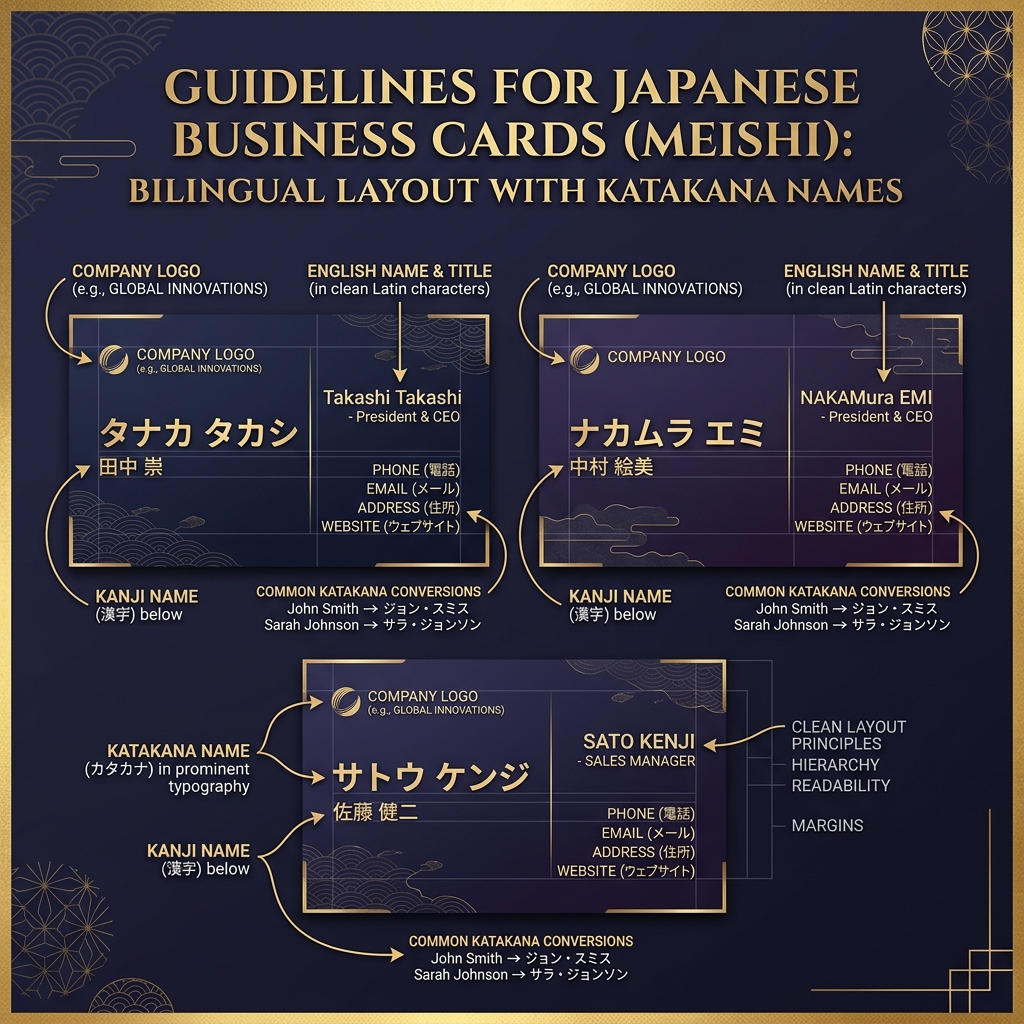
| Japanese Business Cards (Meishi) | Contextual Bilingual Format | スミス ジョン / John Smith | Front side in Japanese Katakana (Surname First); reverse in English (Given Name First). |
| School / Classroom Roster | Family Name First | スミス・ジョン (Smith John) | Maintains alphabetical or syllabic roster uniformity alongside Japanese students. |
For detailed rules on formatting your name for corporate networking, continue reading our companion guide on Katakana Names on Business Cards (Meishi Etiquette).
Try the Tool: Generate Your Japanese Name
Need to verify how your surname and given name look formatted with authentic Japanese Katakana punctuation?
Generate Your Full Name in Japanese Script
Use our dedicated Japanese Name Converter Tool to see your surname, given name, and middle name correctly formatted in authentic Katakana.
Try Japanese Name Converter →Frequently Asked Questions
Why do Japanese people put their family name first?
Japanese name order reflects centuries of East Asian cultural tradition where the collective family unit takes priority over the individual. Placing the surname first immediately identifies an individual's lineage and familial allegiance before denoting their individual persona.
Should foreigners write their names family-name-first in Japan?
In casual social settings and introductions, foreigners typically use Western order (Given Name + Family Name: e.g., ジョン・スミス John Smith). However, on official Japanese administrative paperwork, bank applications, residence cards, and tax forms, foreigners must write their names in passport order: Surname first (e.g., スミス・ジョン Smith John).
Can I introduce myself using '-san' (e.g., 'I am John-san')?
No, never! In Japanese grammar and etiquette, honorific suffixes like -san (さん), -sama (様), and -sensei (先生) are used exclusively to elevate and respect other people. Attaching an honorific to your own name sounds conceited or bizarre. Simply introduce yourself as 'Smith desu' (スミスです) or 'Smith to mōshimasu' (スミスと申します).
What do 姓 (sei) and 名 (mei) mean on Japanese forms?
On Japanese forms, 姓 (sei) or 氏 (shi) designates your Family Name (Surname), while 名 (mei) designates your Given Name (First Name). If a form asks for フリガナ (Furigana), write your Katakana pronunciation in the respective boxes.
Where does a middle name go on Japanese official documents?
Japan has no legal concept of a middle name. On official documents, middle names are legally attached directly to your given name in the '名' (Mei) box or combined as a single continuous string matching your passport's machine-readable zone.
Sources & References
- Ministry of Foreign Affairs of Japan (外務省) — Announcement on the International Order of Japanese Names in Romanization (2019/2020)
- Immigration Services Agency of Japan (出入国在留管理庁) — Residence Card Administration & Name Inscription Guidelines
- Japanese Bankers Association (全国銀行協会) — Foreign Resident Account Opening Standards and Katakana Transliteration
- Agency for Cultural Affairs, Japan — Handbook on Japanese Keigo & Social Etiquette