Why Foreign Names Are Unique in Japanese
Your name is the cornerstone of your personal and professional identity. When stepping into the Japanese-speaking world—whether you are traveling, studying abroad, communicating with Japanese colleagues, or relocating to Tokyo—learning how to write your name in Katakana is the very first step toward making yourself understood.
Many beginners instinctively assume that their name will be translated into Kanji (Chinese ideograms) based on its literal historical meaning (such as translating "Peter" into the Kanji for "Rock" or "Sophia" into "Wisdom"). In modern Japanese society, however, this practice is virtually non-existent for Western names. Instead, Japanese adheres to a strict grammatical and orthographic convention: all foreign names from non-Kanji cultures are written in Katakana (カタカナ).
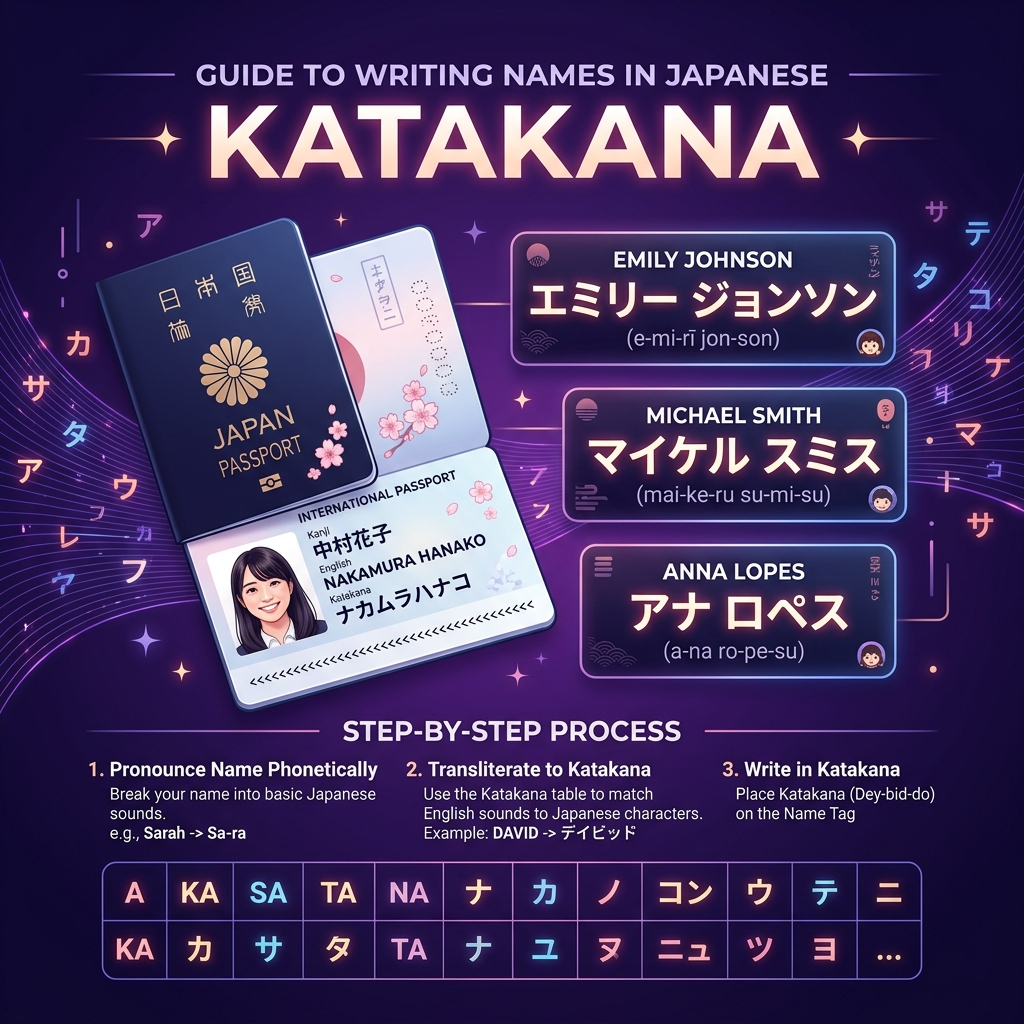
Katakana serves as an immediate visual signal to Japanese readers that a word or personal name originates from abroad. Because Katakana is an entirely phonetic script, translating your name does not mean finding an equivalent meaning; it means transcribing how your name sounds using the phonetic building blocks of the Japanese syllabary. You can test your transliteration instantly using our free katakana converter.
For common English and international names (like Michael, Sarah, or David), Japanese has centuries of established standard Katakana conventions. Even if a slightly different spelling seems technically closer to your regional accent, using the established Katakana spelling guarantees that Japanese speakers will immediately recognize and pronounce your name without hesitation.
The Phonetic Dilemma: The L/R, V, and TH Challenge
Why can't you simply match English letters to Katakana one-for-one? The reason lies in fundamental phonological differences between English and Japanese speech architecture.
1. The Strict Consonant-Vowel (CV) Structure
English is a consonant-cluster-heavy language. A single English syllable like "strengths" packs three consonants before the vowel and four consonants after it. In contrast, Japanese consists almost entirely of open syllables following a strict Consonant + Vowel (CV) structure (with the sole exception of the standalone nasal ン n).
When an English name contains adjacent consonants or ends in a hard consonant stop (such as "Chris" or "Smith"), Japanese speakers physically cannot pronounce those consonants in isolation without inserting a supporting "cushion" vowel. As a universal rule:
- Consonants ending in T or D take the supporting vowel [o]: Kate → ケイト (ke-i-to); David → デビッド (de-bid-do).
- Most other consonants (K, S, P, B, G, F) take the supporting vowel [u]: Mark → マーク (mā-ku); Chris → クリス (ku-ri-su).
2. English Sounds That Do Not Exist in Japanese
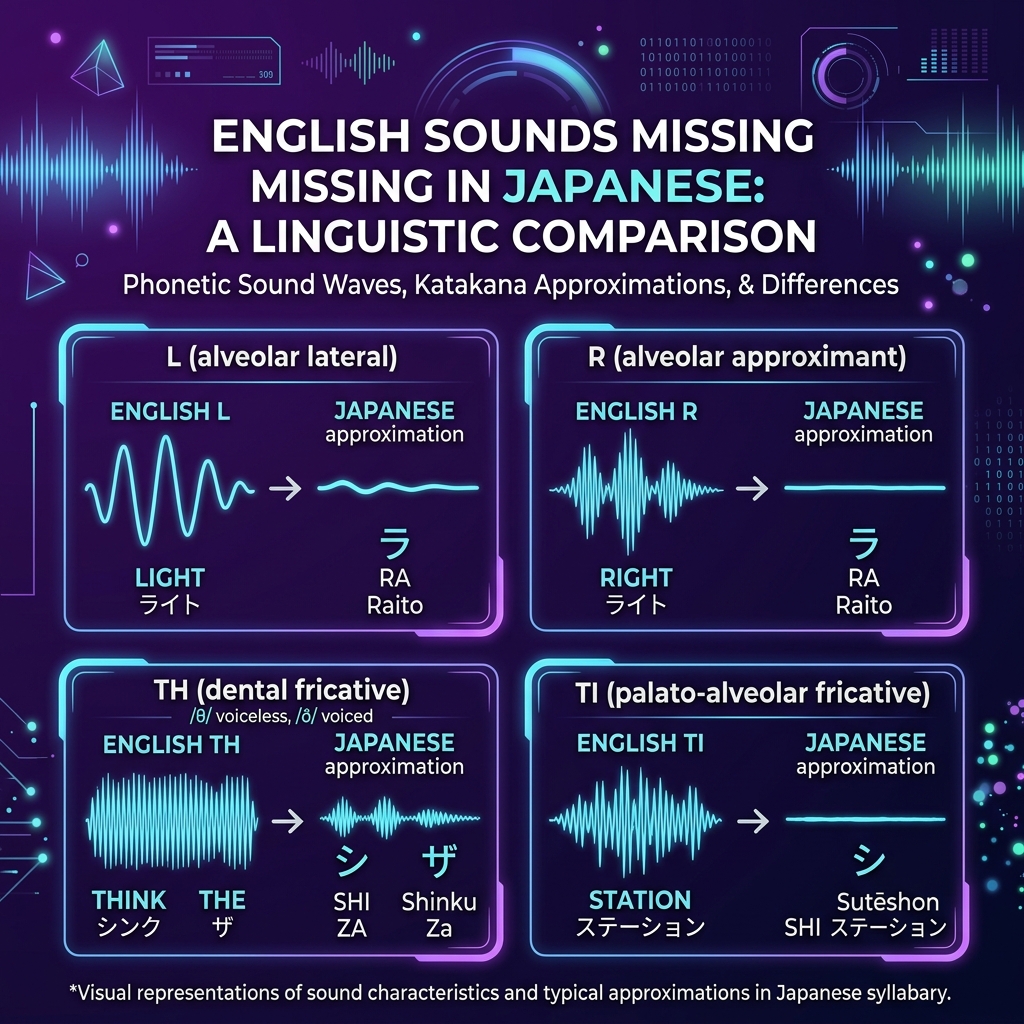
English contains several phonemes that simply do not exist in the traditional Japanese vocal inventory. When transliterating your name, standard workarounds must be applied:
- The L vs. R Sound: Japanese does not have an English "L" (alveolar lateral approximant) or an English "R" (postalveolar approximant). Instead, it uses a single alveolar flap—the Japanese R-row (ラ, リ, ル, レ, ロ). Whether your name is Luke or Robert, both map to the Japanese R-row (Luke → ルーク; Robert → ロバート). For an exhaustive breakdown, explore our companion analysis on English Sounds That Don't Exist in Japanese.
- The "V" Sound: Classical Japanese lacks a "V" fricative, traditionally substituting the voiced bilabial B-row (バ, ビ, ブ, ベ, ボ). Modern Katakana allows the specialized dakuten character ヴ (vu), giving you a choice between conversational and modern spellings: Victor → ビクター (bikutā) or ヴィクター (vikutā).
- The "TH" Sounds: Japanese has no dental fricatives (neither unvoiced /θ/ as in Arthur nor voiced /ð/ as in Heather). Unvoiced "TH" converts to the S-row (Arthur → アーサー āsā; Smith → スミス sumisu). Voiced "TH" converts to the Z-row (Heather → ヘザー hezā).
The 4-Step Method to Convert Any Name
Follow this systematic four-step formula to accurately transcribe any first name or surname into standard Katakana.
| Step | Action | Golden Rule | Working Example (Christopher) |
|---|---|---|---|
| Step 1 | Isolate Pronunciation (Not Spelling) | Ignore silent letters entirely. Transcribe how you speak the name out loud in natural conversation. | "KRIS-tuh-fer" (ignore 'ch' spelling, ignore final 'er' vowel letters). |
| Step 2 | Segment into Japanese Morae | Insert cushioning vowels ([u] or [o]) to break up consonant clusters into open syllables. | K → ku, RI → ri, S → su, TO → to, FER → fā (ku - ri - su - to - fā). |
| Step 3 | Assign Katakana Characters | Map each mora to its base, dakuten, or yoon Katakana equivalent. | ku (ク) + ri (リ) + su (ス) + to (ト) + fa (ファ). |
| Step 4 | Apply Length Marks (ー) & Sokuon (ッ) | Use the chōonpu dash (ー) for stretched vowels and the small tsu (ッ) for clipped consonant stops. | Stretch the final syllable: クリストファー (Kurisutofā). |
15 Comprehensive Worked Examples
Here are 15 real-world worked examples covering common male, female, and unisex names. Each entry displays the original English name, standard Katakana transcription, Japanese phonetic reading, and the specific sound-adaptation rationale applied.
| Name | Katakana | Romaji Reading | Sound Adaptation Rationale |
|---|---|---|---|
| Michael | マイケル | ma-i-ke-ru | Diphthong "My" becomes マイ (ma-i). Hard 'k' takes supporting vowel 'e' followed by 'ru' for the final 'l'. |
| Sarah | サラ / セーラ | sa-ra / sē-ra | サラ is the standard international biblical pronunciation; セーラ mimics modern American elongation (Sair-uh). |
| David | デイヴィッド / デビッド | de-i-vid-do / de-bid-do | デイヴィッド uses modern ヴ with small ィ plus sokuon ッ before 'do'. デビッド is the classic conversational spelling. |
| Emily | エミリー | e-mi-rī | The final "ly" vowel sound is lengthened with a chōonpu dash (ー) to reflect natural English stress. |
| Alexander | アレクサンダー | a-re-ku-san-dā | The 'x' (/ks/) splits into ク (ku) and サ (sa). The final 'der' stretches into a long vowel (ダー). |
| Jessica | ジェシカ | je-shi-ka | Uses the contracted sound ジェ (je) followed by standard シ (shi) and カ (ka). |
| Matthew | マシュー | ma-shū | The English "th-yew" blend (/θjuː/) naturally converts to the palatalized glide シュ with long vowel (ー). |
| Olivia | オリヴィア / オリビア | o-ri-vi-a / o-ri-bi-a | L becomes R (リ). The "vi" can be written either with modern ヴィ (vi) or standard conversational ビ (bi). |
| Christopher | クリストファー | ku-ri-su-to-fā | Breaks up consonant clusters (chr → kuri; st → suto) and uses extended loanword combination ファ (fa). |
| Elizabeth | エリザベス | e-ri-za-be-su | L becomes R (リ). Voiced 'z' maps to ザ (za), and unvoiced final 'th' maps to standard ス (su). |
| William | ウィリアム | wi-ri-a-mu | Begins with the modern W-glide combination ウィ (wi), followed by リ (ri), ア (a), and ム (mu). |
| Chloe | クロエ | ku-ro-e | Standard European transliteration: Chl → クロ (ku-ro), oe → エ (e). Three distinct, crisp morae. |
| Arthur | アーサー | ā-sā | The starting 'Ar' becomes a long vowel アー. The unvoiced 'th' converts to the S-row with long vowel (サー). |
| Lucas | ルーカス | rū-ka-su | Initial 'Lu' becomes elongated ルー (rū), followed by カ (ka) and terminal ス (su). |
| Rachel | レイチェル | re-i-che-ru | Diphthong 'Ray' becomes レイ (re-i). The palatal affricate 'chel' becomes チェ (che) followed by ル (ru). |
The Middle Dot (・) and Name Order in Japan
Unlike English, written Japanese does not use spaces between words. If you write your given name and surname consecutively without punctuation (e.g., マイケルスミス), a Japanese reader cannot immediately discern where your first name ends and your family name begins.
To solve this, Japanese typography uses a centered middle dot known as the nakaguro (中黒 / ・). The nakaguro serves as the universal separator for foreign names:
- Standard Format: マイケル・スミス (Michael Smith)
- Full Name with Middle Name: ジョン・フィッツジェラルド・ケネディ (John Fitzgerald Kennedy)
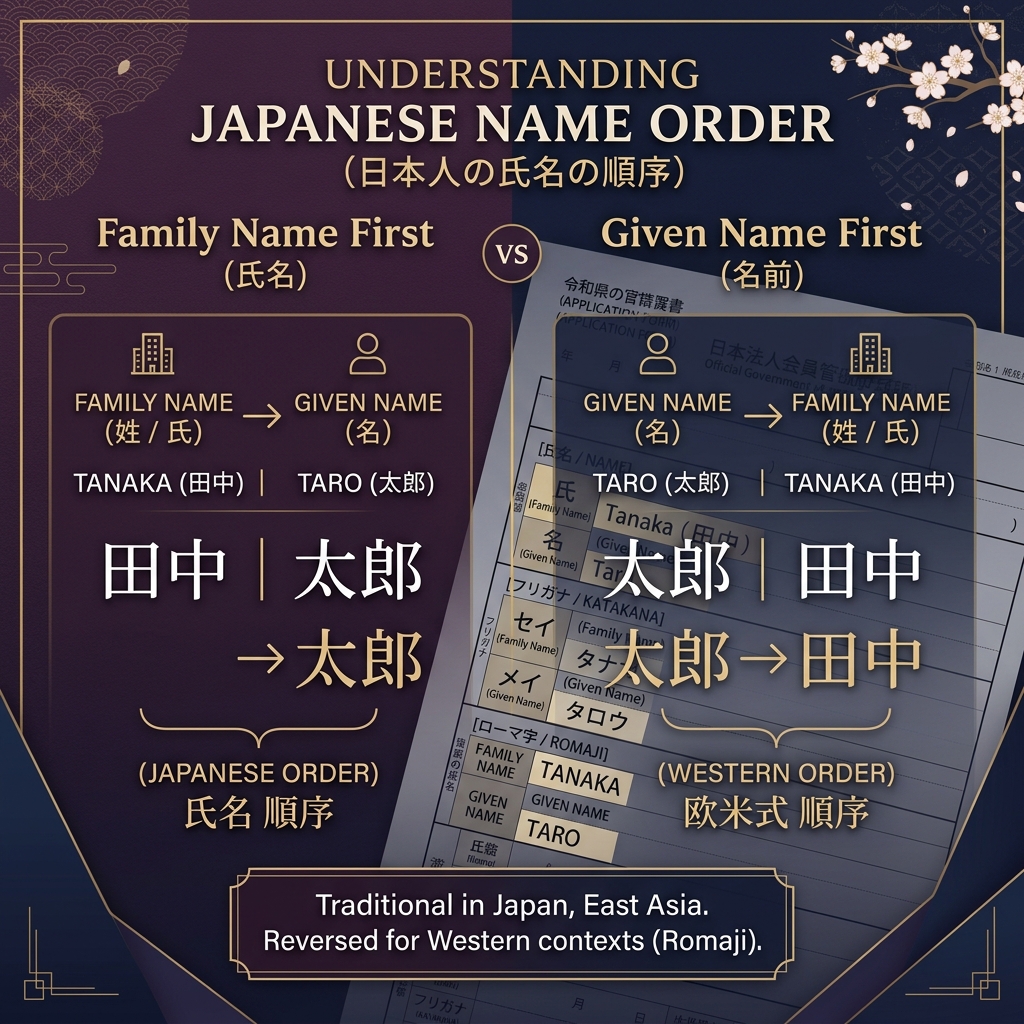
When presenting your name in Japan, you will also encounter the question of name order. Traditional Japanese culture places the family name first, followed by the given name. For an in-depth guide on when foreigners should invert their names and how to fill out government documents, read our comprehensive guide on Japanese Name Order Explained.
When to Ask a Native Speaker
While automated tools and phonetic charts provide 95% of what you need, there are crucial situations where you should verify your Katakana spelling with a native Japanese speaker before committing to it:
1. Official Legal Registration (Tsūshōmei / 通称名): If you live in Japan and register a legal Katakana alias on your resident certificate (jūminhyō), bank account, or health insurance card, changing it later is legally arduous. Ensure your spelling is verified first.
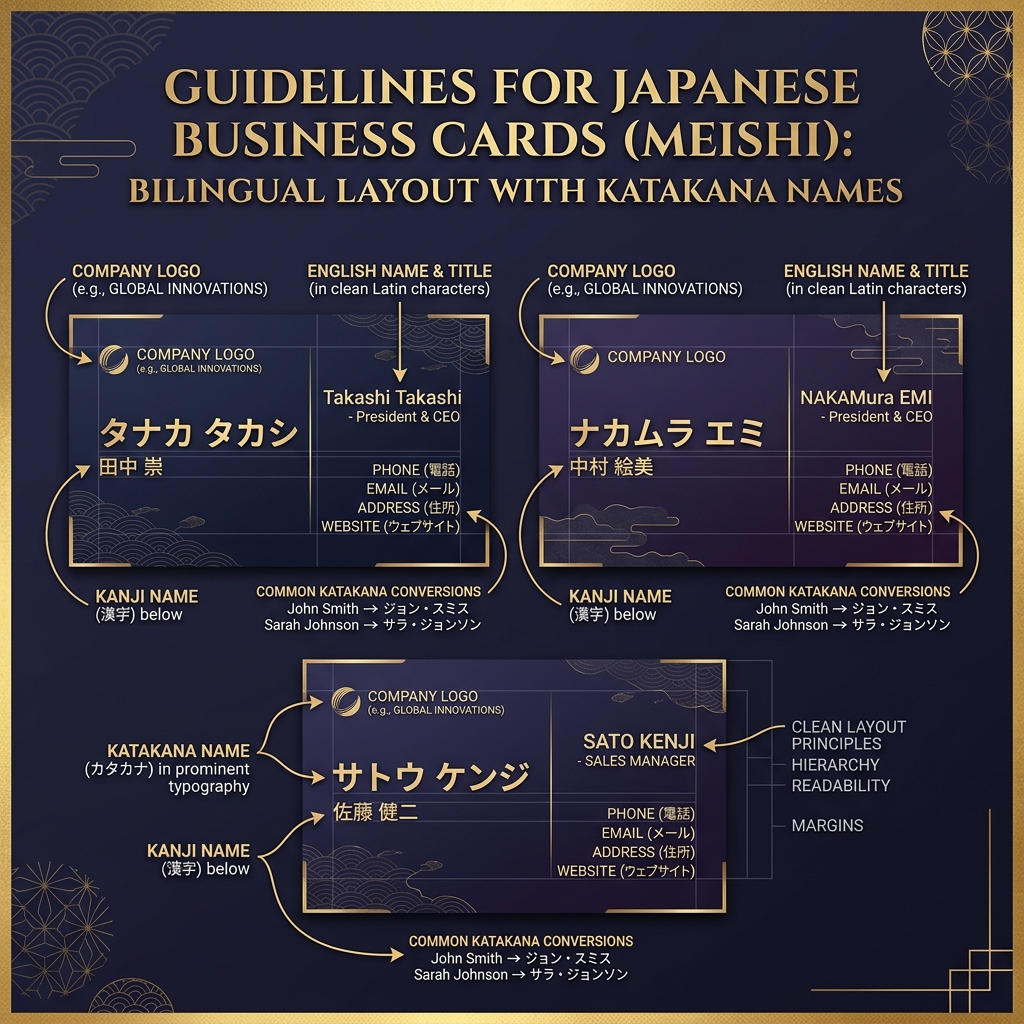
2. Printing Expensive Materials: Before commissioning custom business cards (meishi), hanko seals, or corporate marketing collateral, have a native speaker check the balance and readability.
3. Unintended Japanese Homophones: Ensure that your foreign name does not accidentally sound identical to an awkward or comedic Japanese word (e.g., the name "Skip" turning into スキップ or names sounding like colloquial slang).
The Katakana Name Ecosystem: Essential Deep Dives
Mastering your personal name in Katakana is just the beginning. Depending on your goals, explore our specialized companion guides across the Katakana naming ecosystem:
| Guide | Topic Covered | Key Takeaway |
|---|---|---|
| Famous Names in Katakana | Celebrity, Athlete & Anime Names | Learn how Hollywood actors and global icons write their names, and steal their spelling patterns for your own. |
| English Sounds That Don't Exist in Japanese | Phonetic Adaptation & Sound Rules | Master the exact linguistic mechanics of how L/R, V, TH, and SI/TI clusters are systematically resolved. |
| Japanese Name Order Explained | Surname First vs. Given Name First | Understand family-name-first conventions, official forms, and why honorifics (-san/-sama) are never part of your name. |
| Katakana Names on Business Cards | Meishi Etiquette & Layout Norms | Discover where to place your Katakana name on bilingual business cards, recommended font sizes, and layout mistakes. |
| Baby Names in Katakana | Multicultural & International Naming | How to select bilingual baby names with positive Japanese sound symbolism, clean legal registration, and native harmony. |
Try the Tool: Convert Your Name Now
Ready to see your own name rendered in authentic Japanese Katakana? You don't have to guess which cushioning vowels or length marks apply to your specific surname.
Instantly Generate Your Official Katakana Name
Use our specialized Name to Katakana Converter or our dedicated English Name to Katakana Tool to convert any first name, surname, or full international name into accurate, publication-ready Japanese script.
Convert Your Name → English Name Tool →Frequently Asked Questions
How do you write a non-Japanese name in Japanese?
Non-Japanese names are written using Katakana, the phonetic syllabary reserved for foreign loanwords, international names, and foreign locations. Rather than translating the meaning of your name into Kanji, your name is transcribed phonetically based on how it sounds, mapping its syllables to the closest Japanese Katakana mora.
Why does my name sound different in Katakana?
Japanese phonology relies on a strict consonant-vowel (CV) syllable structure and lacks several common English sounds, including the English 'L', 'V', 'TH', and standalone consonant clusters (like 'str' or 'kt'). English sounds must be adapted to Japanese phonetic rules—such as inserting buffering vowels (usually 'u' or 'o') and substituting 'L' with the Japanese flap 'R'.
Should I use Kanji or Katakana for my official name in Japan?
Foreigners should always use Katakana for everyday interactions, business cards, and informal documents. On legal residency documents (such as your Residence Card or Zairyū Card), your name is officially recorded in the Latin alphabet matching your passport. You can register an official legal Katakana alias (tsūshōmei) with your local city hall if you need it for bank accounts, contracts, or health insurance.
How do I separate my first name and last name in Katakana?
In Japanese writing, words are not separated by spaces. Instead, foreign names use a centered typographical dot called a nakaguro (・) between the given name and surname—for example, 'David Smith' is written as デイヴィッド・スミス.
Can a foreign name have more than one valid Katakana spelling?
Yes. Because transliteration is based on pronunciation rather than spelling, variations often exist. For example, 'David' can be written as デビッド (classic conversational) or デイヴィッド (modern phonetic using the 'V' character ヴ). Similarly, 'Sarah' can be rendered as サラ (short vowels) or セーラ (mimicking English vowel elongation).
Sources & References
- Ministry of Justice, Japan (法務省) — Guidelines on Foreign Resident Name Registration and Katakana Transliteration
- Agency for Cultural Affairs, Government of Japan (文化庁) — Guidelines for the Notation of Foreign Words (外来語の表記)
- The Japan Foundation — Standards for Japanese Language Pedagogy and Romanization
- NHK Broadcasting Culture Research Institute — Rules for Foreign Personal and Place Name Transcription