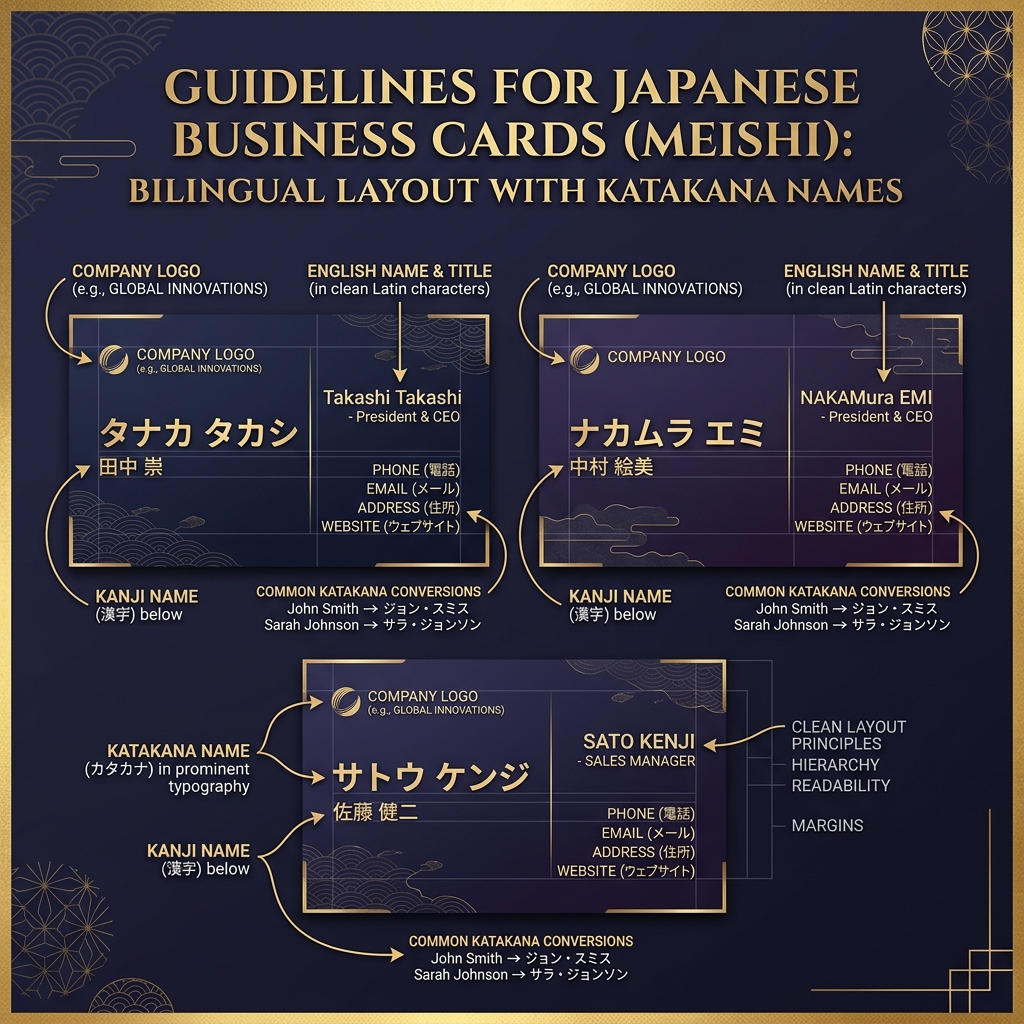
The Sanctity of Meishi: Why Business Cards Matter in Japan
In Western business culture, a business card is a utilitarian networking artifact—frequently slipped into a pocket, scribbled on with a ballpoint pen, or digitized into an app before being discarded. In Japan, however, the business card—known as meishi (名刺)—is considered nothing less than a physical extension of a person's soul and corporate standing.
The ritual exchange of business cards (meishi kōkan, 名刺交換) is the ceremonial commencement of every commercial interaction. Before any pitch, presentation, or small talk occurs, participants stand, bow, exchange cards with both hands, study each other's credentials, and place the received cards reverently atop a leather card case. Showing up to a Japanese corporate meeting without professional meishi is viewed not merely as an oversight, but as an acute display of unpreparedness.
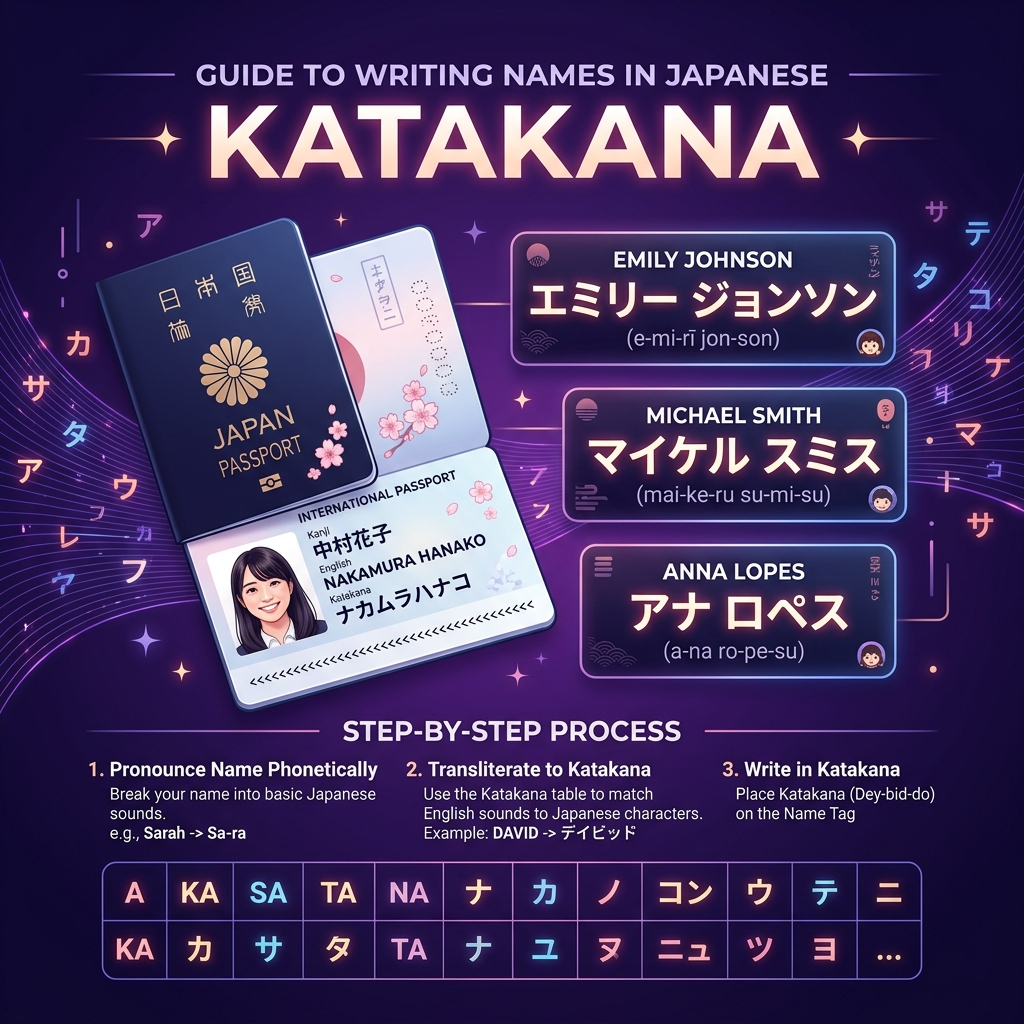
Before designing your business card, make sure your name transliteration follows standardized orthography. You can prepare your name with our katakana converter, or consult our pillar guide on How to Write Your Name in Katakana.
Why Having Your Katakana Name Is Non-Negotiable
Many international businesspeople ask: "Can't I just use my standard English business card when visiting Tokyo?" While Japanese professionals will politely accept an English-only card, doing so creates an invisible wall of awkward friction.
Even Japanese executives with good English reading comprehension frequently experience deep anxiety over mispronouncing unfamiliar foreign names out loud. A name like "Geoffrey Vaughn" or "Siobhan Campbell" contains silent letters and non-intuitive phonetic combinations that freeze Japanese speakers.
By providing your name in clear, authentic Katakana (ジェフリー・ヴォーン), you liberate your counterpart from fear. They immediately know how to address you as "Vaughn-san" or "Geoffrey-san" with total confidence.
Where to Place Your Katakana Name: 3 Standard Layouts
Depending on your printing budget and corporate branding, there are three industry-standard ways to format foreign names on Japanese business cards:
| Layout Model | Front Side (Side A) | Reverse Side (Side B) | Best Used For |
|---|---|---|---|
| 1. Bilingual Double-Sided (Gold Standard) | 100% Japanese: Company name in Japanese/Katakana, Japanese department, Japanese job title, prominent Katakana Name with English underneath in small type. | 100% English: Global company name, English title, Latin alphabet name, international phone numbers (+81). | International executives, expatriates living in Japan, global sales professionals, and consultants. |
| 2. Single-Sided Furigana / Ruby Model | Hybrid Layout: Latin alphabet name printed in large bold typography (12–14pt), with your Katakana name printed directly above it in small ruby type (6–8pt). | Blank, corporate logo, or company mission statement. | Short business trips, tech conferences, trade shows, and budget-conscious entrepreneurs. |
| 3. Japanese-First Vertical Layout (Tategaki) | Traditional vertical Japanese formatting (top-to-bottom right-to-left) with Katakana name written vertically down the center spine. | Horizontal English layout. | Traditional Japanese industries: manufacturing, construction, legal firms, and government relations. |
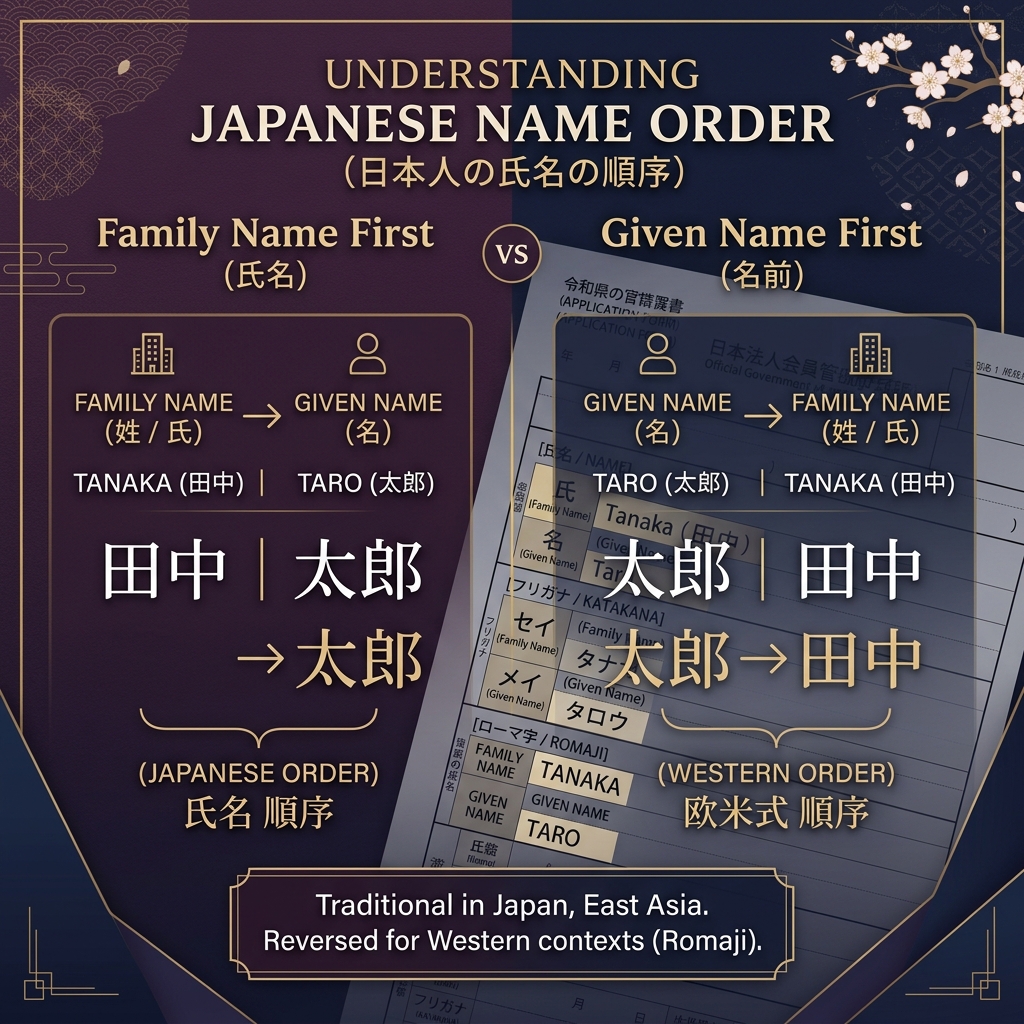
For more details on whether your surname or given name should appear first on the Japanese side, review our analysis on Japanese Name Order Explained.
Typography, Font & Sizing Norms
Japanese typography operates on distinct aesthetic guidelines compared to Western graphic design. To look authentic and prestigious, follow these typographical rules:
1. Japanese Font Pairings (Gothic vs. Mincho)
- Gothic (ゴシック体 - Sans-Serif): Clean, modern, highly legible at small sizes. Used by tech startups, software companies, engineering firms, and modern consumer brands. Recommended system fonts: Yu Gothic, Hiragino Sans, or Meiryo.
- Mincho (明朝体 - Serif): Elegant, traditional, brush-stroke calligraphy feel. Used by financial institutions, law practices, medical firms, luxury hotels, and traditional manufacturing. Recommended system fonts: Yu Mincho or Hiragino Mincho.
2. Typographical Hierarchy & Sizing
- Primary Name (氏名): 12pt to 15pt bold font. This should be the single most prominent element on the card.
- Furigana / Ruby Katakana: 6pt to 8pt, precisely centered directly above the Latin or Kanji characters.
- Company Name (会社名): 10pt to 12pt bold font.
- Job Title (役職): 8pt to 10pt regular font, positioned immediately preceding or above your name.
- Contact Information (連絡先): 7pt to 9pt regular font with generous line spacing.
3. The Golden Rule of Full-Width Characters (Zenkaku)
Always format Japanese text in full-width characters (全角, zenkaku). Never use cramped, outdated half-width Katakana (半角, hankaku), which looks distorted and unprofessional on premium printed stationery.
Corporate Title Traps: Translating Your Position
Japanese corporate hierarchy is strictly defined by standardized executive rankings. Blindly translating Western job titles through automated tools can lead to embarrassing status misunderstandings:
| Western Corporate Title | Japanese Equivalent (Kanji) | Romaji | Hierarchical Standing in Japan |
|---|---|---|---|
| President / CEO | 代表取締役社長 | Daihyō Torishimariyaku Shachō | Ultimate corporate authority; legally empowered representative director. |
| Vice President / EVP | 取締役副社長 / 専務取締役 | Fukushachō / Senmu Torishimariyaku | Senior board-level executive. |
| General Manager / Department Head | 部長 | Buchō | Division leader; wields substantial decision-making and budgetary power. |
| Section Chief / Team Manager | 課長 | Kachō | Front-line operational manager with day-to-day team oversight. |
| Senior Specialist / Lead | 係長 / 主任 | Kakarichō / Shunim | Senior individual contributor or junior supervisor. |
| Account Executive / Staff | 担当 / 社員 | Tantō / Shain | Standard operational team member. |
5 Critical Meishi Etiquette Blunders to Avoid
Printing immaculate Katakana business cards is only half the battle. When handing your card to a Japanese executive, avoid these five catastrophic etiquette mistakes:
1. Covering the Received Name with Your Thumbs
When receiving a business card with both hands, grip the bottom corners. Never place your thumbs over the person's name or corporate logo. In Japanese cultural psychology, covering someone's name is akin to placing your hand over their face.
2. Writing on the Business Card in Front of the Person
In the West, jotting down notes on the back of someone's card is common practice. In Japan, writing on someone's card while in their presence is an extreme insult. If you must record notes, wait until after the meeting has concluded.
3. Shoving the Card into Your Wallet or Pocket
Never slide a received card directly into your pants pocket or billfold wallet. Cards must be placed carefully inside a dedicated leather business card case (名刺入れ, meishi-ire). During the meeting, leave the cards neatly arranged on top of your case on the conference table.
4. Presenting the Card Upside Down
When presenting your card across the conference table, ensure the text faces the recipient so they can read your Katakana name immediately without having to rotate it.
5. Printing Cards with Faded, Inaccurate Katakana Spelling
Using a misspelled or awkwardly phonemic Katakana name signals carelessness. Always verify your spelling with native experts and tools before submitting files to the printer.
Pre-Print Meishi Quality Checklist
Before giving final approval to your commercial printing vendor (such as VistaPrint Japan, Mojoprint, or Graphic), verify these critical checkpoints on your digital proof:
- Bleed & Margin Tolerances: Ensure all Katakana text sits at least 3 mm inside the cut line to prevent accidental trimming errors.
- Resolution & Vectors: Ensure Japanese fonts are converted to vector outlines (アウトライン化, outorain-ka) in Adobe Illustrator or PDF/X to eliminate missing font substitution bugs.
- Full-Width Punctuation: Ensure the middle dot (・) is a full-width typographic glyph, not a floating western hyphen or period.
- Paper Stock (Kami): Standard Japanese meishi uses substantial card stock between 180 kg and 220 kg (roughly 220–300 gsm). Cheap, floppy paper sends a negative subconscious signal about your financial stability.
- Double-Sided Orientation: Ensure both sides share the same top-edge orientation so that flipping the card over doesn't display the reverse side upside down.
Try the Tool: Generate Full-Width Katakana
Need to generate immaculate full-width Katakana for your upcoming business card print run?
Prepare Your Name for Professional Print Design
Use our dedicated Full-Width Katakana Name Tool or our primary Name to Katakana Converter to ensure your Katakana name is 100% full-width (全角) and ready for print typography.
Full-Width Name Tool → Name to Katakana →Frequently Asked Questions
Should a foreigner have their name in Katakana on a Japanese business card?
Yes, absolutely. Having your Katakana name on your business card (meishi) is considered essential professional etiquette in Japan. Without Katakana, Japanese business partners may feel anxious about mispronouncing your English name and may hesitate to address you during meetings.
Where should the Katakana name be positioned on a meishi?
On a bilingual double-sided card, your Katakana name is prominently placed on the Japanese side (often in large font with the Latin alphabet below in smaller type). On a single-sided card, your Katakana name is printed as small ruby/furigana text directly above your Latin alphabet name.
What Japanese font should I choose for Katakana on a business card?
Modern corporations, tech startups, and international firms typically use clean Sans-Serif fonts like Gothic (ゴシック体) such as Meiryo, Yu Gothic, or Hiragino Sans. Traditional industries, legal firms, and luxury brands frequently prefer classic Serif fonts like Mincho (明朝体).
What is the standard size for a Japanese business card?
The standard Japanese business card size (known as standard 4-gou / 4号) is 91 mm × 55 mm (approximately 3.58 × 2.16 inches). This is slightly taller and narrower than standard US business cards (3.5 × 2 inches), so ensure your print vendor uses authentic Japanese dimensions to fit Japanese meishi holders.
Should I use full-width or half-width Katakana for my card design?
Always use full-width Katakana (全角カタカナ) for professional print design. Half-width Katakana (半角) was an archaic legacy constraint from 1980s computer memory and looks cramped, cheap, and distorted on high-end printed stationery.
Sources & References
- Japan External Trade Organization (JETRO) — Business Etiquette in Japan: Guide to Meishi Exchange
- Tokyo Chamber of Commerce and Industry — Standard Corporate Governance & Executive Title Classifications
- Japan Graphic Designers Association (JAGDA) — Standards in Japanese Commercial Typography & Paper Specifications
- Agency for Cultural Affairs, Japan — Guidelines on Foreign Resident Name Registration and Katakana Transliteration